
Survey 4I
Overview
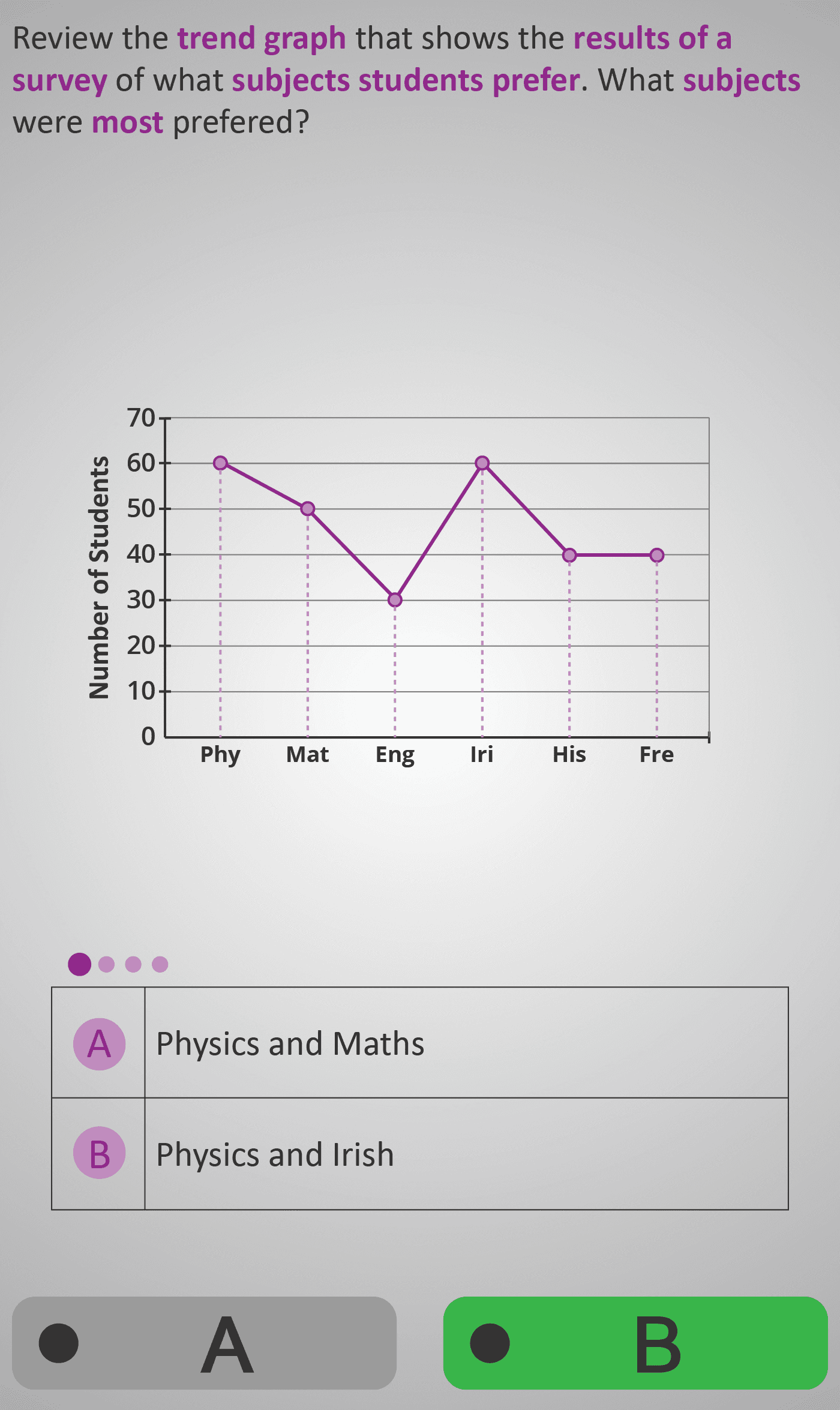
In this Phlow, students analyse a line graph showing subject preferences to determine which subjects are most and least popular. They then calculate the difference between those values, reinforcing subtraction and comparative reasoning through data interpretation.
Each question isolates one micro-step: identifying peaks and troughs, reading values, and expressing the difference numerically. This supports both conceptual understanding and procedural accuracy in a visual, relatable context.
Worked Example
Subjects: Physics 60, Maths 50, English 30, Irish 60, History 40, French 40

Step 1: Highest = Physics (60) and Irish (60)
Step 2: Lowest = English (30)
Step 3: Difference = 60 − 30 = 30

Interpretation:
The most popular subjects have 30 more preferences than the least popular subject.
Step Sequence
- Read the data points from the line graph.
- Identify the subject(s) with the highest and lowest values.
- Subtract the smaller value from the larger value.
- State and interpret what the difference represents.
Sample Prompts
- Which subject is most preferred?
- Which subject is least preferred?
- What is the difference between these values?
- What does this difference tell you about the data?
Why This Matters
This Phlow connects graph interpretation with numerical reasoning. It builds foundational data skills for real-world interpretation — from comparing sales or scores to analysing trends in surveys and reports.
Prerequisite Knowledge Required
- Understanding subtraction as “difference between two numbers.”
- Reading points accurately on a line graph.
- Recognising maximum and minimum values in datasets.
Linked Phlows:
Survey 4G – Interpreting Distance–Time Graphs,
Survey 4H – From Line Graphs to Fractions and Percentages,
Bar Chart 3B – Reading and Comparing Category Totals,
Subtraction 3A – Calculating Differences.
Main Category
Data & Graphs / Comparing Values
Estimated Completion Time
Approx. 10–14 seconds per question.
40 questions total → Total time: 7–10 minutes.
Cognitive Load / Step Size
Low to moderate. Students move gradually from recognising extremes to calculating numerical differences. The step progression supports cognitive balance between visual recognition and mathematical operation.
Language & Literacy Demand
Minimal. Instructions are brief and supported by visual cues. Key comparative words (“most,” “least,” “difference”) are colour-coded, ensuring accessibility even for students with lower literacy levels.
Clarity & Design
- Consistent purple data line and labelled dots highlight values clearly.
- Vertical dashed lines align data points with axis values.
- Flat, uncluttered background ensures strong contrast and readability.
- Visual continuity maintained from earlier Survey Phlows.
Curriculum Alignment (ROI Junior Cycle Mathematics)
- Strands: Data & Algebra (Functions and Patterns)
- Learning Outcomes: Read and interpret data from line graphs; compare and describe values using subtraction; explain trends and differences using appropriate mathematical language.
Engagement & Motivation
The relatable survey context — students’ own subject preferences — sustains engagement. The combination of visual discovery (spotting peaks) and numeric challenge (calculating gaps) keeps learners motivated.
Error Opportunities & Misconceptions
- Confusing “most” with “least.”
- Reading the wrong axis value or rounding incorrectly.
- Subtracting in the wrong order (small − large).
- Overlooking ties for the highest or lowest values.
Transferability / Real-World Anchoring
High. Understanding how to compare highs and lows in data is key to interpreting results in sports, finance, science, and everyday decision-making. Students build transferable analytical skills for life and future learning.
Conceptual vs Procedural Balance
Balanced, with conceptual emphasis. Students apply subtraction procedures within a conceptual framework of range and comparison, learning to describe “how much more” or “how much less” using real data.
Learning Objectives Addressed
- Identify maximum and minimum values in a dataset.
- Calculate the numerical difference between two data points.
- Interpret and describe data range visually and numerically.
- Apply subtraction to meaningful real-world contexts.
What Your Score Says About You
- Less than 20: Recognises graph shape but struggles to link data to operations.
- 21–29: Understands highs and lows but may misread or subtract incorrectly.
- 31–39: Reads data and calculates differences accurately — strong interpretation skills.
- 40 / 40: Expert level — you can quickly identify, compare, and quantify relationships in graphs with precision.