
Time 4A
Overview
This Phlow develops students’ ability to calculate time intervals before and after a given time. Learners work with both analogue and digital representations to add and subtract hours and minutes, deepening their understanding of time as a continuous quantity.
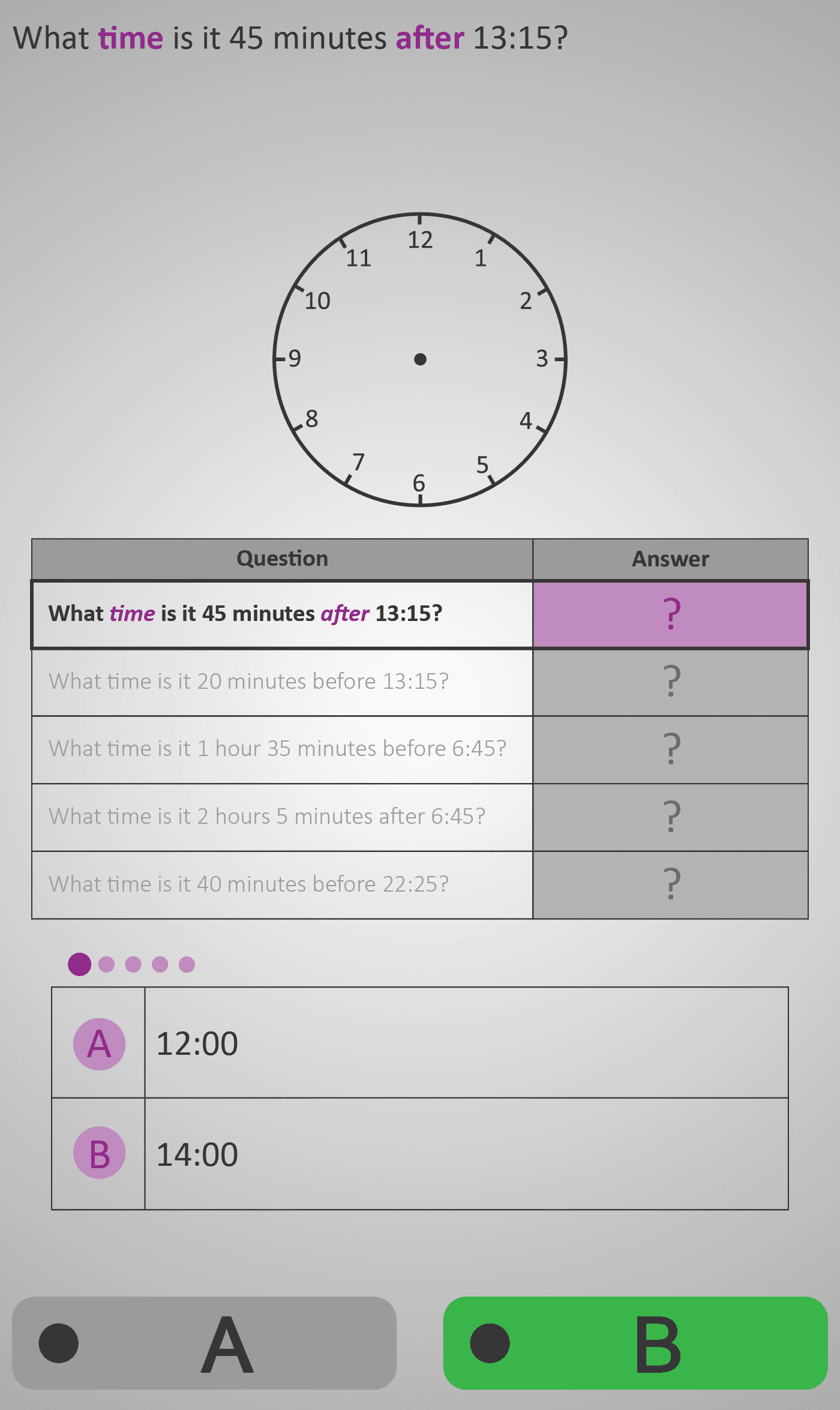
Each question introduces a simple operation — such as “20 minutes before 13:15” or “2 hours 5 minutes after 6:45” — and gradually builds toward more complex time changes. The visual layout and consistent phrasing support accurate reasoning without overloading memory.
Worked Example
Start Time: 13:15
Question: What time is it 20 minutes before?

13:15 − 20 minutes = 12:55
Answer: 12:55
Start Time: 6:45
Question: What time is it 2 hours 5 minutes after?

6:45 + 2:05 = 8:50
Answer: 8:50
Step Sequence
- Read the given time in digital format.
- Identify whether to add or subtract the interval.
- Adjust minutes first, then hours (carry or borrow if needed).
- Convert to 24-hour format when applicable.
- Check your answer with a clock face or estimation.
Sample Prompts
- What time is it 45 minutes before 11:30?
- What time is it 2 hours after 09:15?
- What time is it 1 hour 20 minutes before 17:45?
- What time will it be 3 hours 15 minutes after 22:10?
Why This Matters
Understanding how to calculate time intervals is fundamental for planning, scheduling, and interpreting durations. This Phlow bridges reading static times and reasoning dynamically about elapsed time — preparing learners for real-world applications such as travel timetables or daily routines.
Prerequisite Knowledge Required
- Reading analogue and digital clocks.
- Understanding 12-hour and 24-hour time systems.
- Basic addition and subtraction involving numbers up to 60.
Linked Phlows:
Time 3A – Reading Analogue and Digital Clocks,
Time 3B – Half Past, Quarter To, Quarter Past,
Add/Subtract 3A – Simple Additions and Subtractions.
Main Category
Measurement – Time & Duration
Estimated Completion Time
Approx. 10–14 seconds per question.
40 questions total → Total time: 7–10 minutes.
Cognitive Load / Step Size
Moderate and well-paced. Early screens focus on minute-only changes; later tasks combine hours and minutes. Gradual increases in step complexity maintain engagement and promote flow without overloading working memory.
Language & Literacy Demand
Low. Instructions follow a predictable structure (“What time is it ___ before/after ___?”). Colour-coded key words and concise text keep focus on the mathematical reasoning.
Clarity & Design
- Clean digital time displays supported by empty clock faces for mental visualisation.
- Consistent purple highlights on key operations (“before” / “after”).
- Progress dots and structured layout maintain orientation and pacing.
- Ample spacing and 24-hour examples reinforce accurate interpretation.
Curriculum Alignment (ROI Junior Cycle Mathematics)
- Strand: Measurement
- Learning Outcomes: Read and interpret time in both analogue and digital forms; calculate elapsed time and intervals; relate 12-hour and 24-hour clocks; apply addition and subtraction to time problems.
Engagement & Motivation
The real-world nature of time reasoning makes this task intuitive and rewarding. Alternating between “before” and “after” maintains variety and sharpens focus. Students experience immediate satisfaction in solving realistic scheduling-style problems.
Error Opportunities & Misconceptions
- Crossing the hour boundary when subtracting minutes.
- Mixing up “before” and “after.”
- Neglecting conversion between 12-hour and 24-hour formats.
- Forgetting to adjust both hours and minutes.
Transferability / Real-World Anchoring
Very high. This skill applies daily — planning travel, estimating durations, or managing events. It strengthens broader numeracy and logical reasoning in personal and academic life.
Conceptual vs Procedural Balance
Balanced. Students practise procedural accuracy (time arithmetic) while deepening conceptual understanding of time as a continuous measure that cycles through hours and minutes.
Learning Objectives Addressed
- Add and subtract time intervals accurately.
- Understand “before” and “after” in temporal reasoning.
- Use both digital and analogue representations to solve problems.
- Apply reasoning to real-life scheduling and duration contexts.
What Your Score Says About You
- Less than 20: You recognise time values but need more practice with before/after differences.
- 21–29: You understand most intervals but may confuse before/after or minute-hour transitions.
- 31–39: You calculate efficiently across both 12- and 24-hour formats — strong progress.
- 40 / 40: Full mastery — you can calculate time differences fluently and apply them confidently to real-life scenarios.