
Time 4B
Overview
In this Phlow, students practise reading analogue clocks and converting p.m. times into 24-hour digital format. This reinforces understanding of the relationship between the 12-hour and 24-hour systems, preparing learners to read modern timetables and digital interfaces with confidence.
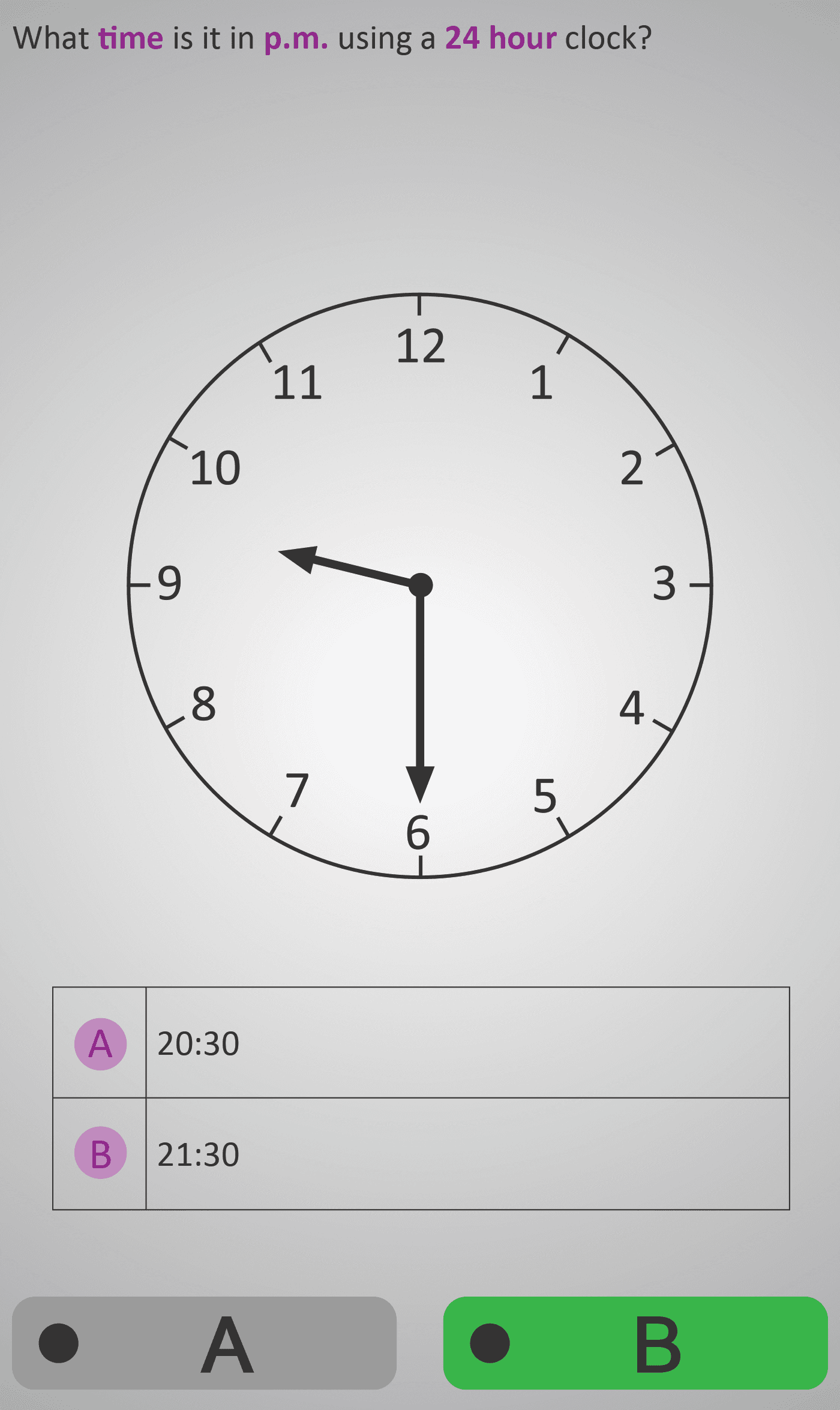
Each screen shows a clock face displaying a p.m. time (e.g., 10:10 p.m.) and asks which 24-hour format (e.g., 22:10) is correct. Through repetition and visual reinforcement, students internalise the key conversion rule:
Add 12 to the hour for all times after 12 noon.
Example: 7:45 p.m. → 19:45
Worked Example
Clock shows: 8:30 p.m.
Conversion: 8 + 12 = 20
Answer: 20:30 (24-hour time)
Step Sequence
- Read the analogue clock carefully (hour hand, minute hand).
- Recognise that it’s a p.m. time (afternoon or evening).
- Add 12 to the hour (except for 12 p.m. itself).
- Write or select the corresponding 24-hour digital format.
Sample Prompts
- What time is shown on the clock in 24-hour format?
- Which of these options shows the correct conversion for 9:10 p.m.?
- How do we change p.m. times into the 24-hour clock?
Why This Matters
Converting between 12-hour and 24-hour formats is an essential real-world numeracy skill. It enables accurate reading of transport timetables, digital displays, and global communication systems that rely on 24-hour notation. This Phlow builds lasting confidence in recognising, interpreting, and applying time formats in everyday life.
Prerequisite Knowledge Required
- Reading and interpreting analogue clock faces (hours and minutes).
- Understanding a.m. and p.m. notation and midday/midnight boundaries.
- Adding and subtracting within 12-hour and 24-hour contexts.
Linked Phlows:
Time 3A – Reading Analogue Clocks,
Time 3B – Matching Analogue and Digital Times,
Time 4A – Adding and Subtracting Time Intervals.
Main Category
Measurement – Time & Representation
Estimated Completion Time
Approx. 10–14 seconds per question.
40 questions total → Total time: 7–10 minutes.
Cognitive Load / Step Size
Low-to-moderate. Each question isolates a single skill — converting one p.m. time — while the minute variations increase slightly to sustain engagement. Ideal for consolidating fluency without cognitive overload.
Language & Literacy Demand
Very low. Instructions are simple and consistent (“What time is it in 24-hour format?”). Colour-coded words like “p.m.” and “24-hour” focus attention on the conversion rule rather than reading complexity.
Clarity & Design
- Large analogue clock faces with clear hand positions.
- Digital options displayed in clean, legible 24-hour format (e.g., 21:10).
- Consistent colour highlighting guides attention to key features.
- Minimalist interface ensures focus on reasoning rather than decoration.
Curriculum Alignment (ROI Junior Cycle Mathematics)
- Strand: Measurement – Time
- Learning Outcomes: Read and convert between analogue and 24-hour digital time; distinguish between a.m. and p.m.; apply conversions in practical, real-world contexts.
Engagement & Motivation
Students immediately recognise the relevance — from mobile phones to transport timetables. The two-choice, rapid-response design builds confidence and gives quick feedback, helping learners reach automaticity in reading and conversion.
Error Opportunities & Misconceptions
- Forgetting to add 12 hours for p.m. times.
- Misreading minute-hand positions on the clock.
- Confusing 12 p.m. and 12 a.m.
- Reversing digits (e.g., writing 20:25 as 22:05).
Transferability / Real-World Anchoring
Very high. Mastering this skill is vital for interpreting timetables, digital clocks, and event schedules. Students gain numeracy competence applicable in school, travel, and everyday decision-making.
Conceptual vs Procedural Balance
Primarily procedural with conceptual reinforcement. Students develop rapid fluency in applying the 12→24-hour conversion rule while reinforcing understanding of time cycles and boundaries.
Learning Objectives Addressed
- Read analogue clock faces accurately.
- Convert 12-hour p.m. times into 24-hour format.
- Understand relationships between time systems and daily cycles.
- Apply conversions confidently in practical contexts.
What Your Score Says About You
- Less than 20: You can read clocks but need to strengthen conversion fluency.
- 21–29: You understand the process but may make small counting or reading errors.
- 31–39: You’re fluent in reading and converting between time systems with strong accuracy.
- 40 / 40: Full mastery — you can instantly and accurately convert any 12-hour p.m. time to 24-hour format.