
Time 4C
Overview
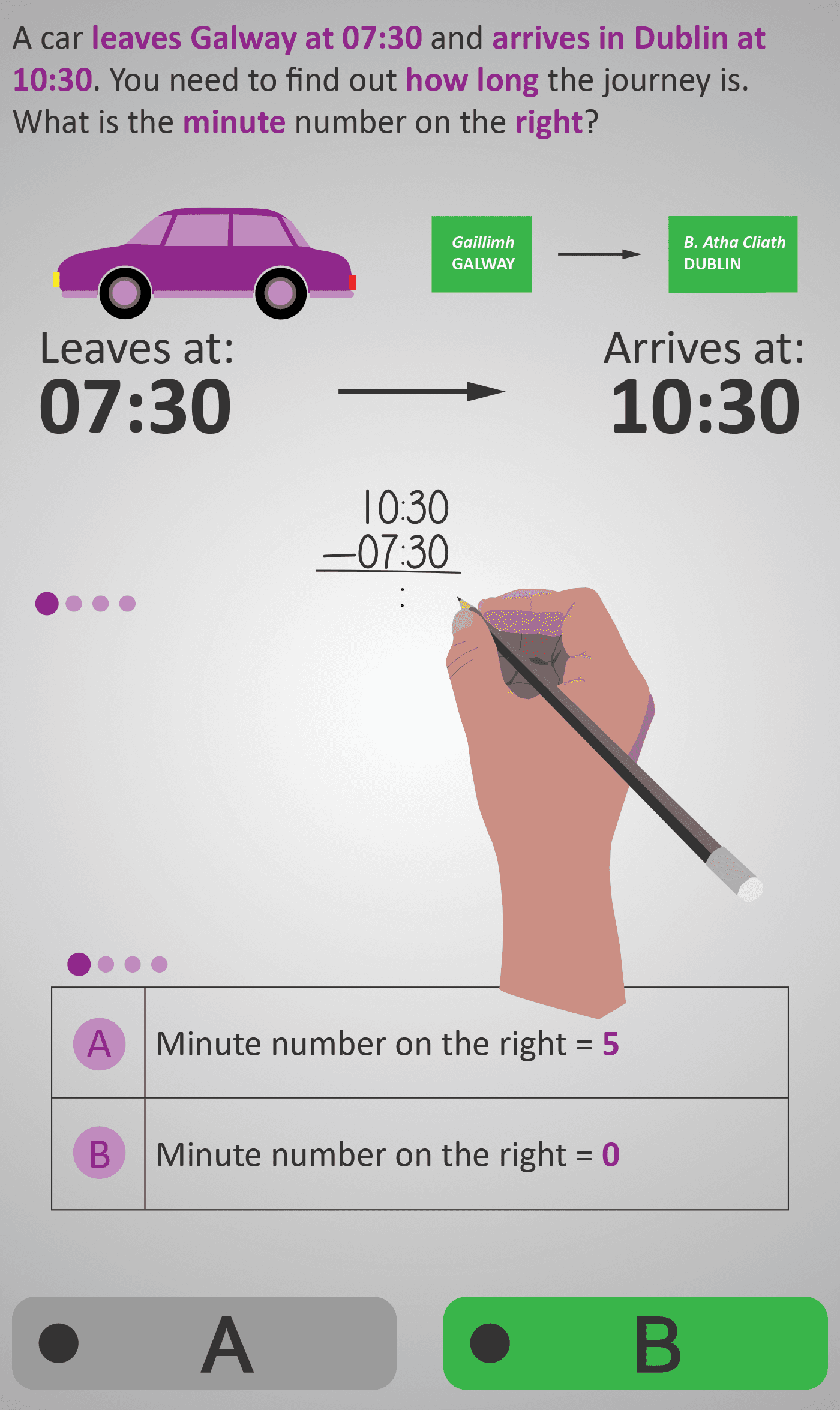
This Phlow teaches students how to find the difference between two times — a foundational real-world skill. Using a guided subtraction layout, learners identify each time component (hours and minutes) before performing full subtraction. The example context — a car journey from Galway to Dublin — helps connect arithmetic to meaningful, everyday applications.
Each screen isolates a single step, allowing students to build the concept progressively: first identifying arrival and departure hours, then minutes, before finally combining them into a complete duration.
Worked Example
Journey: Galway → Dublin
Departure: 07:30
Arrival: 10:30

10:30 − 07:30 = 3 hours
Answer: 3 hours
Step Sequence
- Identify the arrival hour (right-hand side of subtraction).
- Identify the departure hour (left-hand side).
- Identify arrival and departure minutes.
- Subtract hours and minutes separately, aligning vertically.
- Interpret the result as total journey duration.
Sample Prompts
- Which time shows when the car arrived?
- Which time shows when the journey started?
- How many hours apart are 07:30 and 10:30?
- What is the total duration of the journey?
Why This Matters
Understanding time difference is essential in everyday life — from travel and sports to scheduling and exams. This Phlow makes the subtraction process visual and intuitive, guiding learners to align and reason with time values instead of guessing.
Prerequisite Knowledge Required
- Reading analogue and digital clocks accurately.
- Writing digital times using correct format (e.g., 07:30).
- Basic addition and subtraction within 60.
- Understanding 12-hour and 24-hour time notation.
Linked Phlows:
Time 3A – Reading Clocks,
Time 3B – Digital Time Matching,
Time 4A – Adding/Subtracting Time Intervals,
Time 4B – Converting p.m. Times to 24-Hour Format.
Main Category
Measurement – Time (Duration & Difference)
Estimated Completion Time
Approx. 10–14 seconds per question.
40 questions total → Total time: 7–10 minutes.
Cognitive Load / Step Size
Moderate but well-sequenced. Each step isolates one part of the subtraction layout, helping students internalise structured reasoning. The gradual buildup supports fluency and reduces working memory strain.
Language & Literacy Demand
Low-to-moderate. Text includes real-world context (e.g., “A car leaves Galway…”), supported by visuals showing start and end times. Comprehension remains numeric and visual rather than language-heavy.
Clarity & Design
- Side-by-side digital times with labelled “Departure” and “Arrival.”
- Colour-coded subtraction columns (hours and minutes aligned).
- Visual scaffolding with car icons and city labels to anchor meaning.
- Handwritten-style subtraction reinforces real working methods.
Curriculum Alignment (ROI Junior Cycle Mathematics)
- Strand: Measurement – Time
- Learning Outcomes: Calculate time intervals between events; apply addition and subtraction to time; relate real-world contexts to duration problems.
Engagement & Motivation
A familiar journey scenario gives emotional and cultural resonance (Galway → Dublin). The gradual reveal of handwritten steps feels interactive, giving students a sense of guided discovery and mastery.
Error Opportunities & Misconceptions
- Confusing which side of subtraction represents start vs end.
- Subtracting minutes incorrectly (forgetting regrouping).
- Subtracting in the wrong direction (start – end).
- Treating times as unrelated numbers rather than sequential events.
Transferability / Real-World Anchoring
Very high. The same reasoning applies to all forms of time measurement — travel durations, class periods, sports timings, and shift calculations.
Conceptual vs Procedural Balance
Procedural with conceptual grounding. Students practise structured subtraction but also understand why alignment of hours and minutes matters. This bridges real-world time reasoning and abstract arithmetic.
Learning Objectives Addressed
- Identify start and end times correctly.
- Subtract times accurately using structured layouts.
- Understand hours and minutes as separate but linked time units.
- Apply subtraction to real-world scheduling and travel situations.
What Your Score Says About You
- Less than 20: You can read times but may confuse subtraction layout or order.
- 21–29: You align hours and minutes correctly but make occasional calculation errors.
- 31–39: You subtract times confidently with clear procedural fluency.
- 40 / 40: You fully understand how to calculate time differences — accurate, fluent, and ready for advanced duration problems.