
Time 4D
Overview
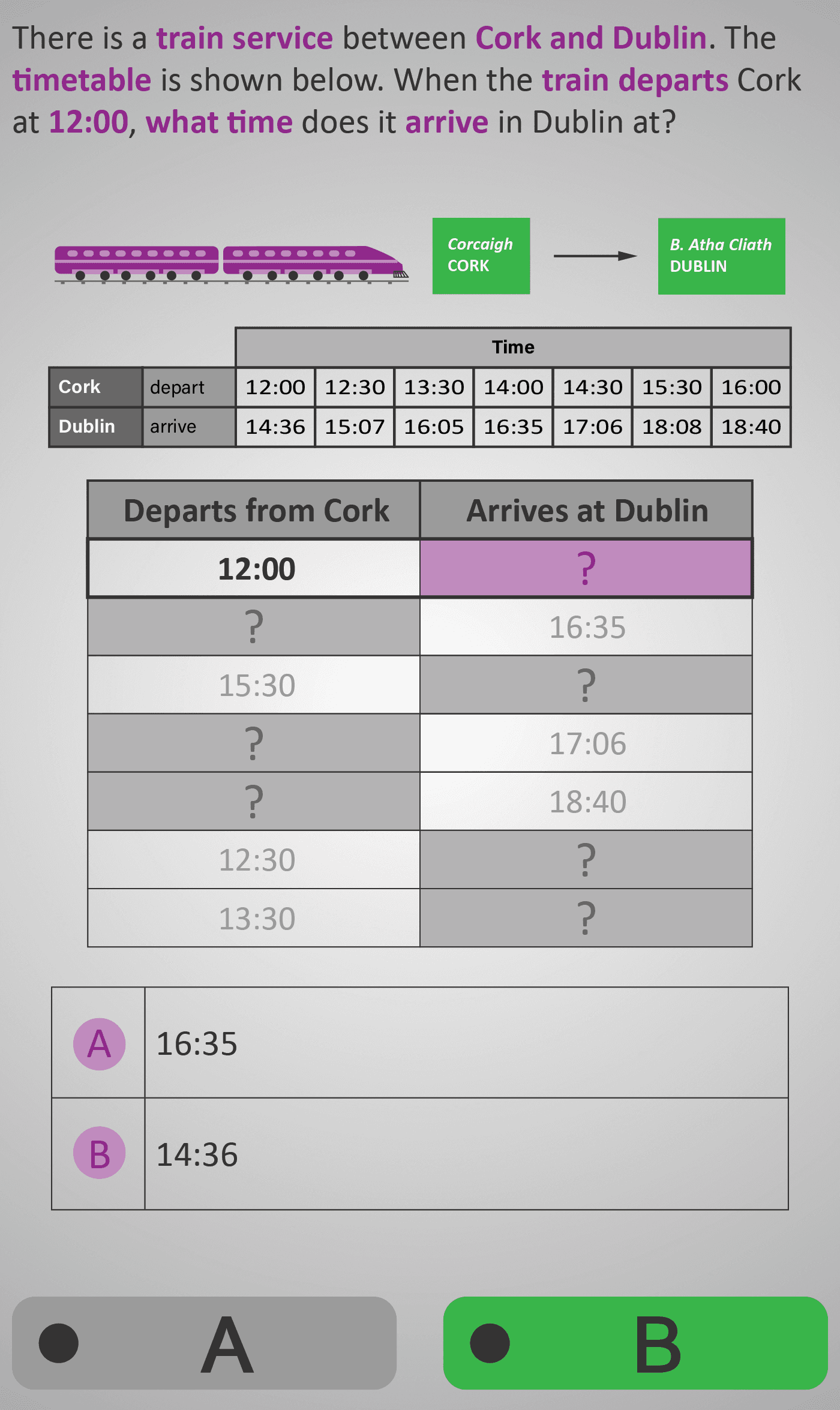
This Phlow helps students apply their knowledge of time arithmetic to real-life data interpretation. Learners analyse a two-way train timetable showing journeys between Cork and Dublin and answer questions about departure and arrival times. Each question involves reading, comparing, or reasoning about time relationships within a table.
The sequence moves from direct lookup (“What time does the 09:00 train arrive?”) to reasoning (“What is the latest train Tara can take to reach Dublin by 18:20?”). This builds both procedural fluency and applied reasoning — transforming abstract time calculations into practical decision-making.
Worked Example
Cork → Dublin Timetable

Depart Cork   | Arrive Dublin
--------------|---------------
09:00         | 11:45
12:00         | 14:45
15:00         | 17:30

Question: What is the latest train Tara can take to arrive before 18:20?

Answer: 15:00 (arrives 17:30)
Step Sequence
- Read the departure and arrival times in the table.
- Locate the correct row that matches the question prompt.
- Compare times to identify which train fits the condition (earliest, latest, before, after).
- Check results visually to confirm logical consistency.
Sample Prompts
- Which train arrives in Dublin at 17:30?
- What time does the 12:00 train from Cork arrive?
- What is the latest departure from Cork to arrive before 18:00?
- If a student arrives at the station at 14:00, which train can they take next?
Why This Matters
Timetable literacy is a functional numeracy skill essential for independent travel and planning. This Phlow helps learners transition from basic time arithmetic to real-world applications — interpreting structured data, making logical comparisons, and reasoning within constraints.
Prerequisite Knowledge Required
- Reading analogue and digital times (12-hour and 24-hour formats).
- Adding and subtracting hours and minutes.
- Calculating differences between two times (duration).
- Recognising “earlier” and “later” relationships.
Linked Phlows:
Time 3A / 3B – Reading and Matching Times,
Time 4A – Adding/Subtracting Times,
Time 4B – Converting p.m. to 24-hour Format,
Time 4C – Calculating Duration between Two Times.
Main Category
Measurement – Time (Timetables & Data Interpretation)
Estimated Completion Time
Approx. 10–14 seconds per question.
40 questions total → Total time: 7–10 minutes.
Cognitive Load / Step Size
Moderate-to-high, effectively scaffolded. Early questions focus on direct lookups; later ones add relational reasoning (“latest possible,” “before,” “after”). The consistent table layout manages cognitive demand and sustains engagement through meaningful challenge.
Language & Literacy Demand
Moderate. Questions use slightly longer sentences but rely heavily on visual and spatial cues. Purple keywords (“latest,” “arrive,” “depart”) and consistent phrasing support comprehension for all literacy levels.
Clarity & Design
- Clear timetable grid with labelled departure and arrival columns.
- Directional icons (Cork → Dublin) enhance contextual understanding.
- Highlighting focuses attention on relevant times and keywords.
- Minimal clutter, ensuring the timetable remains the visual centrepiece.
Curriculum Alignment (ROI Junior Cycle Mathematics)
- Strands: Measurement & Data
- Learning Outcomes: Interpret and use timetables; calculate and compare time intervals; reason logically about order and sequence; solve everyday scheduling problems.
Engagement & Motivation
The authentic train travel scenario resonates with students’ real-world experiences, fostering intrinsic motivation to solve practical problems. The visual realism of the timetable makes mathematics feel useful and purposeful.
Error Opportunities & Misconceptions
- Mixing up rows (reading wrong arrival for a departure).
- Reversing direction (Dublin → Cork vs Cork → Dublin).
- Confusing earlier/later reasoning in “latest train” questions.
- Assuming identical travel times across all services.
Transferability / Real-World Anchoring
Very high. These skills apply directly to transport schedules, class timetables, event planning, and workplace rosters. Mastery here builds functional mathematical confidence — a key goal of the Phlow approach.
Conceptual vs Procedural Balance
Balanced. Students perform procedural lookups and comparisons, but the task’s main emphasis is conceptual — reasoning about order, dependency, and practical constraints.
Learning Objectives Addressed
- Read and interpret real-life timetables accurately.
- Match departure and arrival times using tabular structure.
- Use reasoning to find earliest or latest viable options.
- Apply time knowledge to real-world planning contexts.
What Your Score Says About You
- Less than 20: You can read times but struggle to apply them in relational contexts — practise reading row–column data carefully.
- 21–29: You can match times correctly but occasionally mix up direction or order.
- 31–39: You reason efficiently through timetable data — strong comprehension.
- 40 / 40: Full mastery — confident, accurate, and ready for complex real-world time reasoning tasks.