
Time 4E
Overview
This Phlow completes the “Time” series by integrating all previous understanding of duration, rates, and proportional reasoning. Through guided visual problems, students learn how speed connects distance and time. They apply calculator skills to realistic travel examples involving a car and a bus.
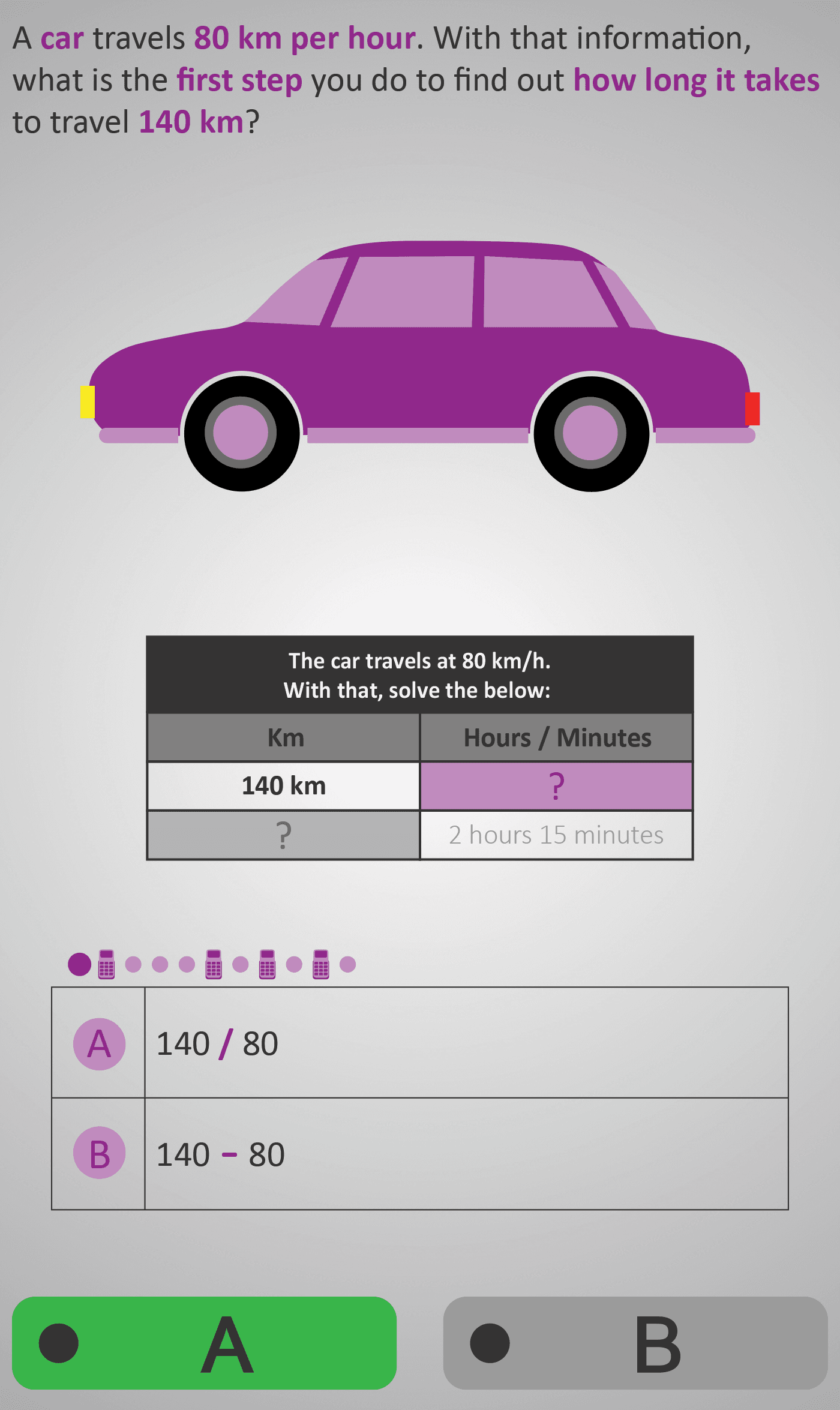
Learners first explore the car scenario at 80 km/h — deciding whether to divide or multiply, calculating
140 ÷ 80 = 1.75, and interpreting 1.75 hours = 1 hour 45 minutes.
They then practise converting between mixed and decimal hours (e.g., 2 h 15 min = 2.25 h) and finding new distances (80 × 2.25 = 180 km).
In the second half, they analyse the bus problem — travelling the same 180 km in 5 hours to find 36 km/h,
and extending this to a new time (3 h 45 min = 3.75 h) to calculate 36 × 3.75 = 135 km.
The final screen compares both journeys: Who travelled faster?
Worked Example
Speed = 80 km/h
Distance = 140 km

Time = Distance ÷ Speed
= 140 ÷ 80
= 1.75 h = 1 h 45 min
Step Sequence
- Identify known and unknown quantities (speed, distance, or time).
- Choose the correct operation — multiply or divide.
- Use a calculator to perform the computation.
- Convert between hours and minutes accurately.
- Compare both travel rates conceptually (car vs bus).
Sample Prompts
- How long does it take a car travelling at 80 km/h to cover 140 km?
- How far does a bus travel in 3 hours 45 minutes at 36 km/h?
- Which vehicle travelled faster overall?
- Convert 1.75 hours to hours and minutes.
Why This Matters
This Phlow transforms time arithmetic into real-world reasoning. Students see how rates connect quantities they encounter daily — journey times, map distances, GPS readings — and learn to select the right operation with confidence. It strengthens both mathematical fluency and decision-making skills beyond the classroom.
Prerequisite Knowledge Required
- Reading and comparing digital and analogue times accurately.
- Adding and subtracting hours and minutes.
- Understanding and converting between 12-hour and 24-hour times.
- Calculating time differences and durations.
- Basic calculator fluency and familiarity with decimal–fraction equivalence (¼ = 0.25, ¾ = 0.75).
Linked Phlows:
Time 3A / 3B – Reading and Comparing Times,
Time 4A – Adding and Subtracting Time Intervals,
Time 4B – Interpreting 24-hour Times,
Time 4C – Calculating Durations,
Time 4D – Reasoning from Timetables.
Main Category
Measurement → Time → Speed, Distance & Time Relationships
Estimated Completion Time
Approx. 10–14 seconds per question.
40 questions total → Total time: 7–10 minutes.
Cognitive Load / Step Size
Moderate-to-high but well scaffolded. Each operation (divide, multiply, convert, compare) is introduced separately, maintaining a steady learning rhythm and minimising overload. Tables, vehicle icons, and calculator symbols provide visual anchors for each concept.
Language & Literacy Demand
Moderate. The phrasing is repetitive and guided by key highlighted terms like “divided by,” “multiplied by,” and “fastest.” Visual cues and colour-coded steps ensure accessibility even for weaker readers.
Clarity & Design
- Distinct car and bus imagery differentiates scenarios.
- Tables shaded in black/grey with purple highlight cells for active input/output.
- Calculator icons signal when computation is required.
- Side-by-side visual comparison at the end reinforces conceptual closure.
Curriculum Alignment (ROI Junior Cycle Mathematics)
- Strand: Measurement – Time
- Learning Outcomes: Explore and apply the relationship Speed = Distance ÷ Time; convert between hours, minutes, and decimals; choose suitable strategies and tools for multi-step time problems; interpret and compare rate information in practical contexts.
Engagement & Motivation
The travel storyline is instantly relatable — students experience problem-solving that mirrors real life. Alternating between car and bus builds curiosity (“Who’s faster?”) and provides continuous narrative motivation.
Error Opportunities & Misconceptions
- Reversing operations (using multiply instead of divide).
- Incorrectly converting minutes to decimals (15 → 0.15 instead of 0.25).
- Misreading decimal hours as minutes (1.75 ≠ 1h 75m).
- Confusing car and bus data when switching scenarios.
Transferability / Real-World Anchoring
Exceptional. This reasoning directly applies to travel planning, GPS interpretation, science experiments, and any rate-based comparisons. Students learn to connect proportional reasoning to authentic decision-making.
Conceptual vs Procedural Balance
Strong balance. Each numeric step is anchored in a meaningful question (“How far?”, “How long?”, “Who’s faster?”). The final comparison question ensures conceptual understanding of rate as a measure of efficiency.
Learning Objectives Addressed
- Understand and apply the Speed = Distance ÷ Time relationship.
- Convert between hours, minutes, and decimal representations.
- Select and execute the correct operation using a calculator.
- Compare travel rates between contexts accurately.
- Apply proportional reasoning to real-world travel and science problems.
What Your Score Says About You
- Less than 20: You understand time arithmetic but need more confidence linking operations to context.
- 21–29: You know the relationships but sometimes mix multiplication/division or decimal conversions.
- 31–39: You apply rate reasoning consistently and compute accurately — strong applied numeracy.
- 40 / 40: Mastery achieved — you can analyse, plan, and compare travel efficiently using real-world data.