
Time 4F
Overview
This Phlow extends learning from Time 4E by moving from single-step travel questions to multi-part journey problems. Learners combine information about distance, time, and speed across two journey legs — developing flexible proportional reasoning and logical sequencing.
Each scenario requires identifying the correct process:
- Use
Speed = Distance ÷ Timeto find missing values. - Convert decimal hours into minutes or vice versa.
- Add distances or durations to find totals.
Realistic contexts — cars, buses, and trains — keep the learning grounded in everyday experience. The emphasis is on reasoning across multiple relationships rather than solving isolated operations.
Worked Example
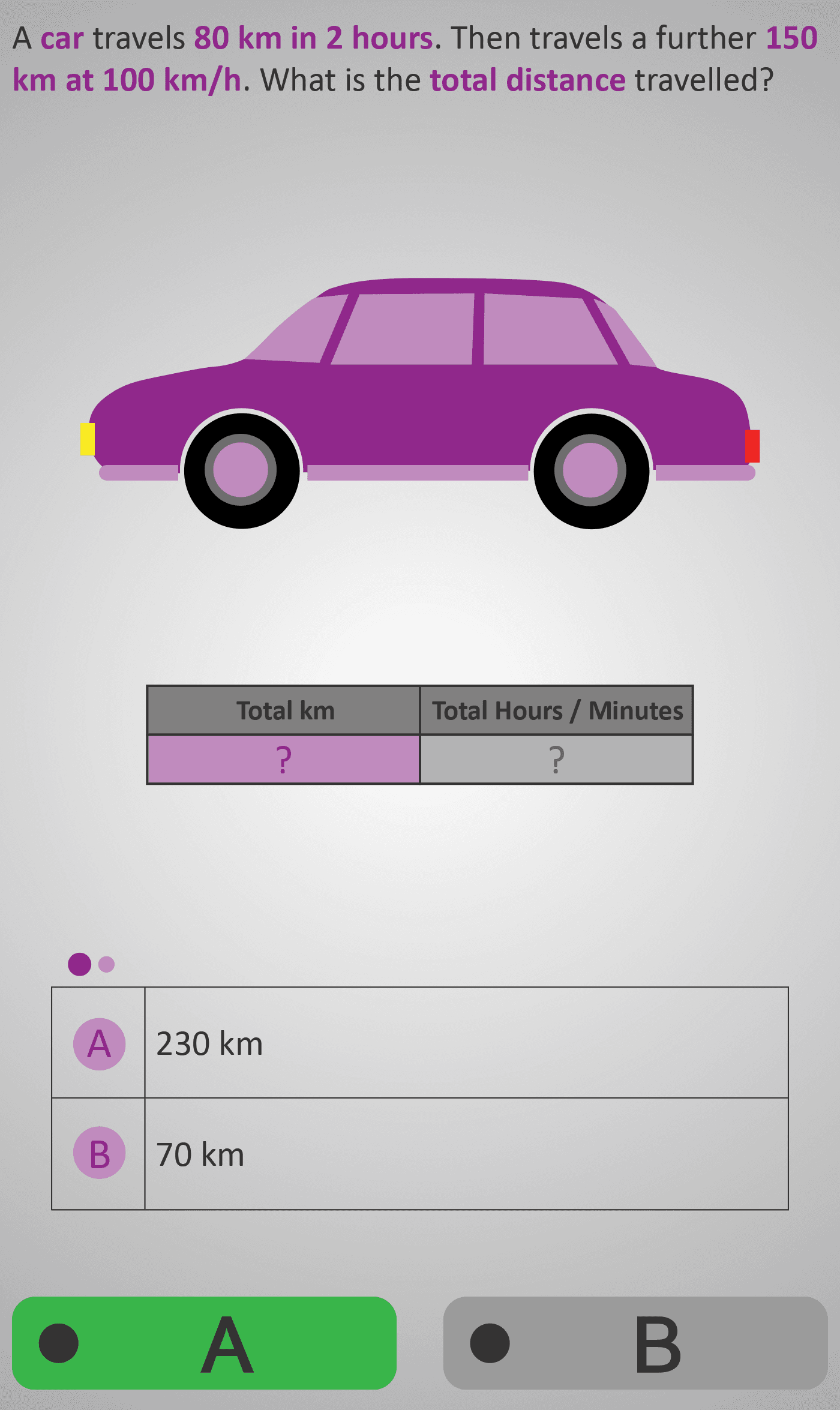
Journey Part 1: 80 km in 2 h
Journey Part 2: 150 km at 100 km/h

Time (Part 2) = 150 ÷ 100 = 1.5 h = 1 h 30 min
Total Time = 2 h + 1 h 30 min = 3 h 30 min
Total Distance = 80 + 150 = 230 km
Step Sequence
- Interpret data for each journey segment (speed, distance, or time).
- Use division or multiplication to find the missing value for the second leg.
- Convert decimals into minutes (e.g., 0.5 h = 30 min).
- Add total times or distances to reach the final result.
- Reflect on which quantity changes additively (distance/time, not speed).
Sample Prompts
- A car travels 80 km in 2 hours, then 150 km at 100 km/h. What is the total journey time?
- A train travels 250 km in 3 hours and another 40 km at 200 km/h. What is the total distance?
- A bus covers 75 km in 1 h 45 min, then 30 km at 60 km/h. What is the total journey time?
- Which journey took the longest overall?
Why This Matters
Multi-step reasoning mirrors real-world problem-solving — from planning trips to interpreting route data in maps or navigation systems. This Phlow cultivates strategic mathematical thinking, encouraging learners to connect concepts, manage information, and calculate efficiently.
Prerequisite Knowledge Required
- Understanding the formula Speed = Distance ÷ Time.
- Confidence converting between hours, minutes, and decimals.
- Experience reading and interpreting travel data or timetables.
- Fluency with addition, division, and unit conversion.
Linked Phlows:
Time 4C – Calculating Time Differences,
Time 4D – Interpreting Timetables,
Time 4E – Speed, Distance & Time Relationships.
Main Category
Measurement → Time → Compound Speed–Distance–Time Problems
Estimated Completion Time
Approx. 10–14 seconds per question.
40 questions total → Total time: 7–10 minutes.
Cognitive Load / Step Size
Moderate-to-high. Each step integrates prior skills into cumulative reasoning. The difficulty rises gradually — first adding distances, then times — maintaining a balanced challenge curve. Tables and clear colour cues reduce working-memory strain by keeping all key data visible.
Language & Literacy Demand
Moderate. Sentences contain embedded quantities but are supported by structured layouts and consistent formatting. Purple highlights emphasise numerical values, allowing students to focus on reasoning rather than heavy reading.
Clarity & Design
- Tables labelled “Part 1 / Part 2 / Total” clearly separate information.
- Icons (car, bus, train) cue the context visually.
- Consistent grey–purple palette enhances readability and focus.
- “Total” labels reinforce the concept of cumulative reasoning.
Curriculum Alignment (ROI Junior Cycle Mathematics)
- Strand: Measurement – Time
- Learning Outcomes: Solve multi-step problems involving distance, speed, and time; use time in decimal and sexagesimal form; apply proportional reasoning and problem-solving strategies in context.
Engagement & Motivation
Each question tells a short, relatable story of a journey. Students feel a genuine sense of purpose — combining stages, calculating totals, and “arriving” at an answer. The alternating transport modes keep the exercise fresh and realistic.
Error Opportunities & Misconceptions
- Adding speeds instead of times or distances.
- Forgetting to convert minutes to decimals before multiplying.
- Incorrect rounding or confusing total columns.
- Choosing the wrong operation for the second leg (× vs ÷).
Transferability / Real-World Anchoring
Very high. These problems directly mirror planning trips, estimating travel times, or analysing multi-route journeys. The reasoning also transfers to science (velocity/time) and geography (map scales and distances).
Conceptual vs Procedural Balance
Balanced. While procedural accuracy is key, students must first interpret the scenario conceptually — deciding which quantities to add and which to calculate via the formula. This strengthens applied problem-solving, not rote method use.
Learning Objectives Addressed
- Combine multiple journey legs to find total distance and time.
- Apply Speed = Distance ÷ Time flexibly to different contexts.
- Convert between hours, minutes, and decimal units accurately.
- Interpret and communicate results clearly using totals.
What Your Score Says About You
- Less than 20: You can solve single-step problems but struggle when journeys involve more than one stage.
- 21–29: You understand each part but may lose track when adding totals — review multi-step structure.
- 31–39: You demonstrate confident proportional reasoning and clear working — strong applied understanding.
- 40 / 40: Full mastery — fluent at combining, converting, and reasoning through real-world multi-step problems.