
Total Cost 4A
Overview
This Phlow introduces practical money arithmetic — adding euro and cent values to find total costs in realistic shopping contexts. Students explore how to recognise when to add, subtract, or multiply while reinforcing decimal place value understanding.
Each screen builds progressively:
- Identify which operation is needed to find a total.
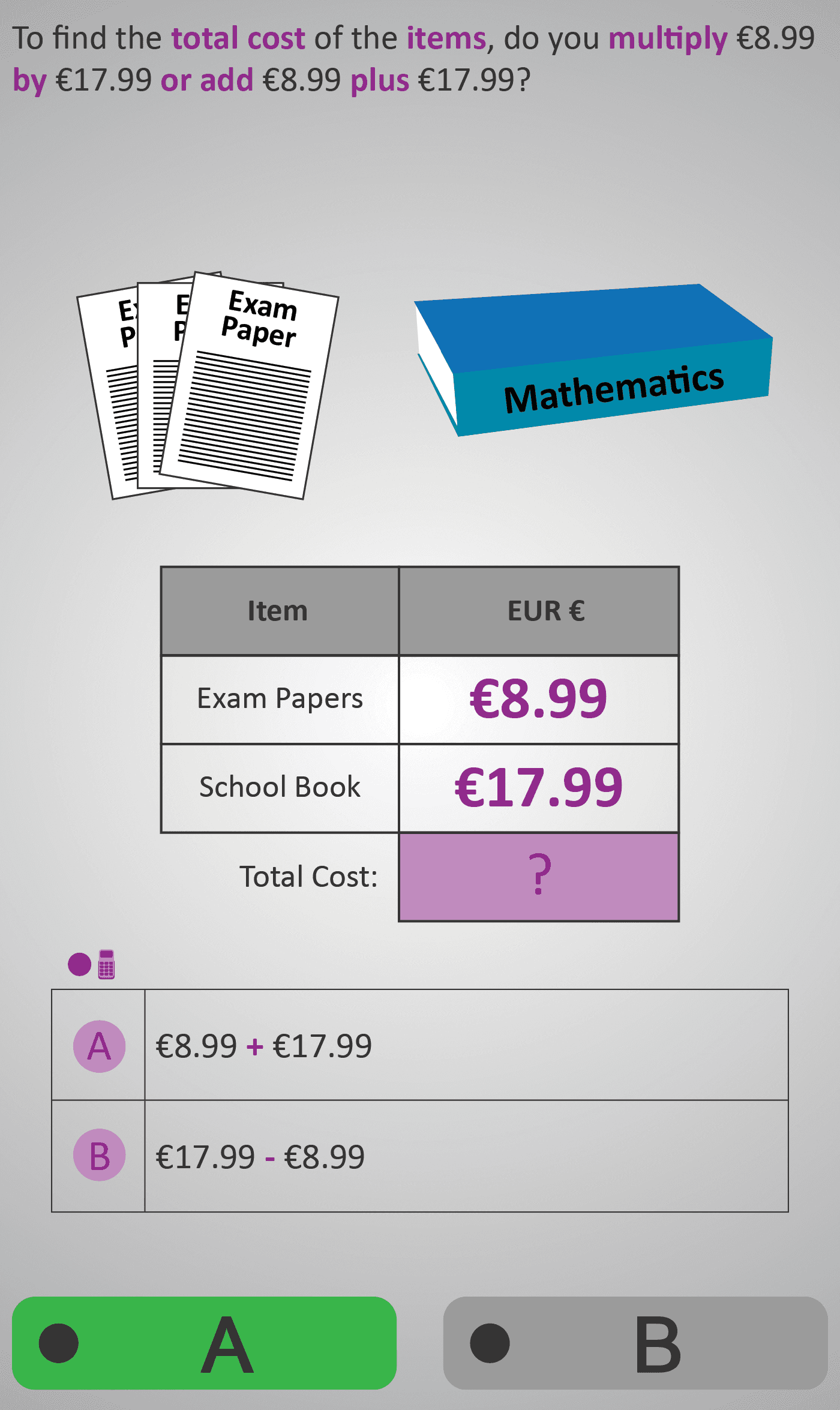
- Add two decimal prices (e.g., €8.99 + €17.99).
- Use a calculator to check answers and interpret meaning.
- Combine multiple prices (e.g., €6.55 + €2.53 + €0.35 + €0.85 + €0.55).
The design mirrors real receipts and shopping lists, showing that mathematics applies directly to daily decisions like budgeting and comparing prices.
Worked Example
Book: €8.99
Exam Papers: €17.99

Total Cost = 8.99 + 17.99 = €26.98
Step Sequence
- Read the price table carefully.
- Decide the operation (add, subtract, or multiply).
- Add euro and cent values correctly, aligning decimal places.
- Check your total using a calculator.
- Interpret what the result means (total cost for all items).
Sample Prompts
- “To find the total cost, should you add or multiply?”
- “What is the total cost of all five items?”
- “How much do two books costing €8.99 each cost in total?”
Why This Matters
Money problems are among the most relevant applications of maths for students. This Phlow strengthens financial literacy by teaching students how to calculate totals accurately and understand decimal operations in real-world terms. It builds independence, accuracy, and confidence in everyday numeracy.
Prerequisite Knowledge Required
- Recognising and writing prices in euro and cent.
- Adding and subtracting decimals using place value.
- Basic familiarity with calculator input and decimal alignment.
Linked Phlows:
Money 3A / 3B – Understanding Euro and Cent,
Add 3 / Subtract 3 – Adding and Subtracting Decimals,
Calculator 3A – Entering Decimals,
Shop 3A – Deciding Which Operation to Use.
Main Category
Number → Arithmetic → Addition of Decimals / Money Calculations
Estimated Completion Time
Approx. 10–14 seconds per question.
40 questions total → Total time: 7–10 minutes.
Cognitive Load / Step Size
Low-to-moderate. The task begins with simple additions and gradually scales up to multiple items. Step size is small enough for comfort while reinforcing understanding of decimal addition. Each new question adds only one variable — an extra price or operation cue.
Language & Literacy Demand
Low. Short, repetitive phrasing (“Find the total cost...”) with key terms highlighted in purple helps focus attention on the maths. Clear visuals and consistent price tables make reading effortless.
Clarity & Design
- Tables display euro and cent in bold purple digits for immediate visibility.
- Icons of school supplies, books, and calculators anchor the context visually.
- Layout consistency supports pattern recognition and confidence.
- Colour palette (grey/purple) promotes calm, focused attention.
Curriculum Alignment (ROI Junior Cycle Mathematics)
- Strand: Number – Money & Decimals
- Learning Outcomes: Perform decimal addition accurately; interpret monetary values correctly; solve practical cost problems; use a calculator appropriately for financial calculations.
Engagement & Motivation
Everyday shopping contexts make learning instantly relevant. Students recognise real products and pricing, making it feel like solving real problems rather than abstract exercises. The calculator icon encourages self-checking and independence.
Error Opportunities & Misconceptions
- Choosing the wrong operation (subtract instead of add).
- Misaligning decimals during addition.
- Forgetting to include all items in a total.
- Mixing euro and cent without converting correctly.
Transferability / Real-World Anchoring
Very high. Students directly apply these skills to shopping, budgeting, and interpreting receipts or online orders. Builds essential financial numeracy for everyday life.
Conceptual vs Procedural Balance
Primarily procedural but contextually reinforced. Students not only add numbers but understand why addition is used for totals — embedding conceptual understanding through use-case reasoning.
Learning Objectives Addressed
- Identify the correct operation for total cost problems.
- Add euro and cent values accurately.
- Use a calculator confidently to verify answers.
- Interpret and communicate totals meaningfully.
What Your Score Says About You
- Less than 20: You recognise money values but need more practice with decimal addition.
- 21–29: You can add simple prices but sometimes skip or misread items.
- 31–39: You add accurately and understand how totals represent combined costs — strong numeracy.
- 40 / 40: You show full mastery — fluent, accurate, and financially confident.