
Total Cost 4B
Overview
This Phlow extends the money skills from Total Cost 4A by combining multiplication and addition in a relatable restaurant setting. Students calculate the total cost for several items and then combine subtotals to find a full bill.
Learners practise:
- Multiplying prices for multiple identical items.
- Adding subtotals to find the combined cost.
- Interpreting unit prices, quantities, and totals in structured tables.
The scenario — a family meal with adults and children — grounds arithmetic in real-life financial reasoning, helping students see when and why to use each operation.
Worked Example
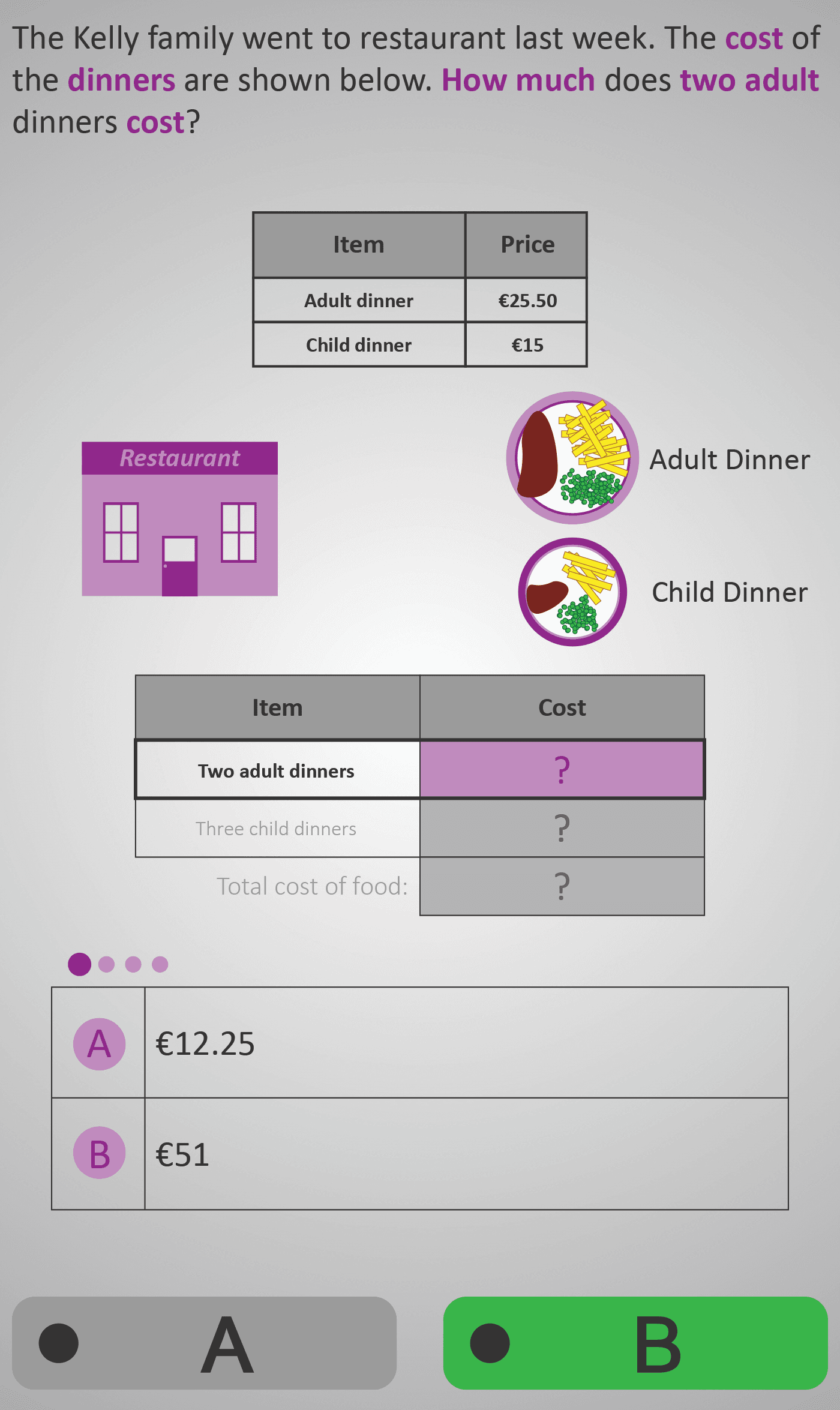
Adult dinner = €25.50 × 2 = €51.00
Child dinner = €15.00 × 3 = €45.00
Total bill = €51.00 + €45.00 = €96.00
Step Sequence
- Read the price list carefully and note the quantities.
- Multiply each item’s price by its quantity.
- Add both subtotals to find the full cost.
- Check calculations using a calculator or estimate mentally.
- Interpret what the result means (the total family bill).
Sample Prompts
- “How much do two adult dinners cost altogether?”
- “What is the cost of three child meals?”
- “What is the total bill for the family?”
- “If each adult meal is €25.50, what is the subtotal for two adults?”
Why This Matters
This Phlow teaches students to combine multiple operations logically — a key numeracy skill in daily life. Understanding how multiplication simplifies repeated addition helps students reason efficiently when managing costs, planning events, or budgeting. It strengthens both financial awareness and operational fluency.
Prerequisite Knowledge Required
- Adding money values to find a total (Total Cost 4A).
- Understanding multiplication as repeated addition.
- Recognising euro and cent notation accurately.
- Using a calculator for multi-step calculations.
Linked Phlows:
Total Cost 4A – Adding Prices in Euro and Cent,
Multiply 3A / 3B – Repeated Addition,
Money 3B – Reading Prices,
Calculator 3A – Multi-Step Input.
Main Category
Number → Arithmetic → Multiplication & Addition of Money Values
Estimated Completion Time
Approx. 10–14 seconds per question.
40 questions total → Total time: 7–10 minutes.
Cognitive Load / Step Size
Moderate. The new challenge — multiplying before adding — is introduced gradually, with clear scaffolding and visual support. Each screen adds one reasoning layer, maintaining engagement without overload. Tables make operations explicit, lowering cognitive demand through visual structure.
Language & Literacy Demand
Moderate. Instructions are simple but include real-world nouns (adult, child, dinner) and numeric details. Key words like “cost”, “total”, and “multiply” are highlighted to guide attention. Visual context ensures comprehension even with limited literacy skills.
Clarity & Design
- Restaurant tables clearly separate unit prices and totals.
- Purple highlights draw focus to essential numbers.
- Meal icons (adult vs child) are instructive and reinforce grouping logic.
- Consistent step-by-step build mirrors how students would solve it on paper.
Curriculum Alignment (ROI Junior Cycle Mathematics)
- Strand: Number – Money & Decimals
- Learning Outcomes: Apply multiplication and addition to real-life money problems; interpret and compute with euro and cent; solve and communicate multi-step solutions using structured reasoning.
Engagement & Motivation
The restaurant theme feels authentic and relatable. Students are motivated by the storyline — calculating a family bill — and enjoy applying abstract arithmetic to meaningful, tangible examples.
Error Opportunities & Misconceptions
- Adding instead of multiplying when calculating multiple items.
- Mixing quantities between groups (2 adults vs 3 children).
- Forgetting to add both subtotals for the total bill.
- Confusing multiplication with subtraction symbols.
Transferability / Real-World Anchoring
Very high. These skills apply directly to everyday budgeting, restaurant bills, family shopping, and event planning. Students gain the confidence to interpret totals and reason about multi-item purchases independently.
Conceptual vs Procedural Balance
Balanced. Conceptually, students learn when and why to use multiplication before addition. Procedurally, they practise accurate computation and calculator use. This reinforces flexible problem-solving rather than memorised steps.
Learning Objectives Addressed
- Use multiplication to find the cost of multiple identical items.
- Add subtotals to calculate the total cost accurately.
- Interpret and organise data in tables or price lists.
- Apply arithmetic reasoning in real-life financial contexts.
What Your Score Says About You
- Less than 20: You can add prices but need more confidence combining multiplication and addition.
- 21–29: You can calculate parts correctly but sometimes miss one operation or subtotal.
- 31–39: You complete all steps accurately and interpret results correctly — strong applied fluency.
- 40 / 40: You demonstrate full mastery — confident in multi-step arithmetic and financial reasoning.