
Total Cost 4C
Overview
This Phlow extends money reasoning from Total Cost 4A and 4B into realistic financial decision-making. Students calculate the total cost of buying a motorbike using an instalment plan versus a single cash payment. It combines multiple operations — multiplication, addition, subtraction, and comparison — to model authentic financial decisions.
Learners move through structured, scaffolded steps:
- Identify given data: Deposit and monthly payment details.
- Multiply monthly cost by number of months to find instalment total.
- Add the deposit to find full cost of Option 1.
- Compare this with the one-off cash price (Option 2).
- Subtract to find the difference and interpret which is cheaper.
Worked Example
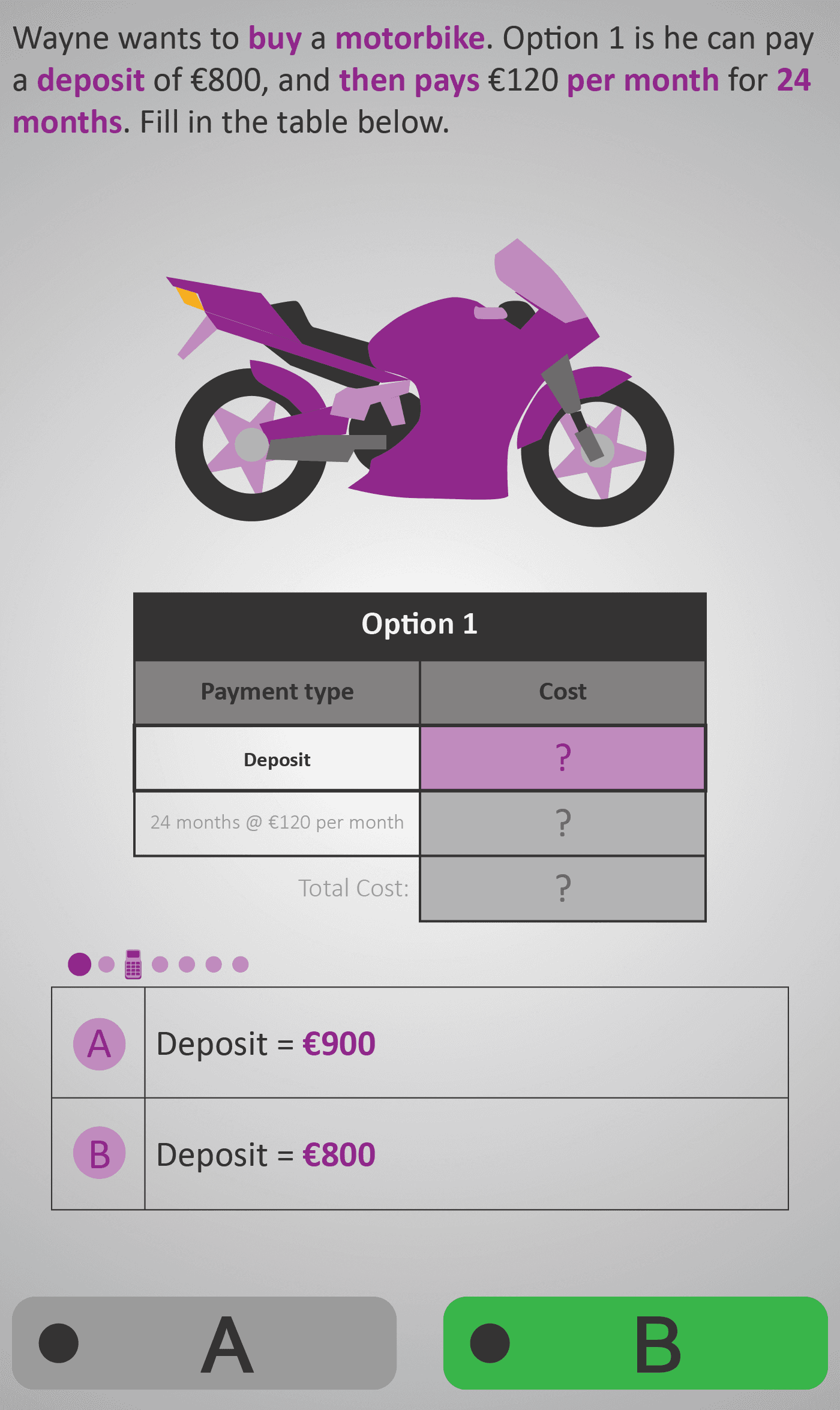
Deposit: €800
Monthly Payment: €120 for 24 months

Instalments = 120 × 24 = €2,880
Total Cost (Option 1) = €2,880 + €800 = €3,680
Single Payment (Option 2) = €3,200
Difference = €3,680 – €3,200 = €480
→ Option 2 is cheaper by €480
Step Sequence
- Extract the key figures from the table (deposit, monthly payment, duration).
- Multiply to find the total payment over the full period.
- Add the deposit to find the total instalment cost.
- Compare both totals and find the difference.
- Interpret the result — which option offers better value?
Sample Prompts
- “What is the total cost of the instalment plan?”
- “Which option is cheaper and by how much?”
- “How much extra does the instalment plan cost overall?”
- “If monthly payments were reduced to €110, what would the new total be?”
Why This Matters
This Phlow builds financial literacy by helping students understand the hidden cost of instalment payments. It shows how arithmetic connects directly to real-world decision-making — a crucial life skill in managing savings, credit, and value-for-money decisions.
Prerequisite Knowledge Required
- Fluency in adding and multiplying money values (Total Cost 4B).
- Understanding subtraction and comparison of totals.
- Confidence using calculators for multi-step problems.
- Basic familiarity with “per month” and “deposit” terminology.
Linked Phlows:
Total Cost 4B – Multiplying and Adding Prices,
Multiply 4A – Repeated Addition,
Subtract 4A – Finding Differences,
Calculator 3A – Performing Multi-Step Operations.
Main Category
Number → Arithmetic → Multi-step Money Problems (Finance & Instalments)
Estimated Completion Time
Approx. 10–14 seconds per question.
40 questions total → Total time: 7–10 minutes.
Cognitive Load / Step Size
Moderate-to-high. Each question requires coordinating multiple values and operations in sequence (multiply → add → compare → subtract). However, the Phlow manages load effectively by isolating each step visually, using consistent tables and highlight cues to sustain flow and comprehension.
Language & Literacy Demand
Moderate. Sentences use natural financial phrasing (“per month”, “cheaper”, “difference”), but purple key words and number tables ensure that even weaker readers can decode meaning efficiently. The scenario is concrete and familiar, supporting comprehension through context.
Clarity & Design
- Consistent two-option (A/B) comparison table format.
- Purple and grey highlighting directs focus to active values.
- Motorbike icon creates narrative continuity and thematic engagement.
- Sequential dots reinforce the multi-step structure visually.
Curriculum Alignment (ROI Junior Cycle Mathematics)
- Strand: Number & Measures – Money
- Learning Outcomes: Solve multi-step problems involving cost and value; compare alternative payment methods; select appropriate operations for practical financial problems; interpret total cost differences and value implications.
Engagement & Motivation
The motorbike story is age-appropriate and aspirational, giving students a meaningful reason to calculate carefully. Comparing two real options creates a sense of decision-making purpose, which keeps motivation high throughout the sequence.
Error Opportunities & Misconceptions
- Dividing instead of multiplying when finding total instalments.
- Forgetting to include the deposit in the total cost.
- Adding before multiplying (incorrect order of operations).
- Subtracting in the wrong direction when comparing totals.
Transferability / Real-World Anchoring
Extremely high. These calculations mirror real financial reasoning — from car loans to mobile contracts. Students learn that instalments often cost more in total, encouraging informed financial choices in future.
Conceptual vs Procedural Balance
Balanced. Procedural accuracy (multiply, add, subtract) is paired with conceptual understanding of value comparison. The “Which option is cheaper?” question ensures students interpret results rather than compute mechanically.
Learning Objectives Addressed
- Multiply unit payments by time to find total cost.
- Add deposits to determine full payment totals.
- Subtract and compare totals to identify cheaper options.
- Apply arithmetic reasoning to real-world finance and value assessment.
What Your Score Says About You
- Less than 20: You can follow single operations but struggle to link multiple steps together — revisit 4B first.
- 21–29: You understand the idea but may misorder operations or comparison steps — review the sequence carefully.
- 31–39: You compute all steps correctly and understand why one option is cheaper — strong applied reasoning.
- 40 / 40: You demonstrate full mastery — fluent in financial comparisons and confident applying arithmetic to real-world money problems.