
Total Cost 4D
Overview
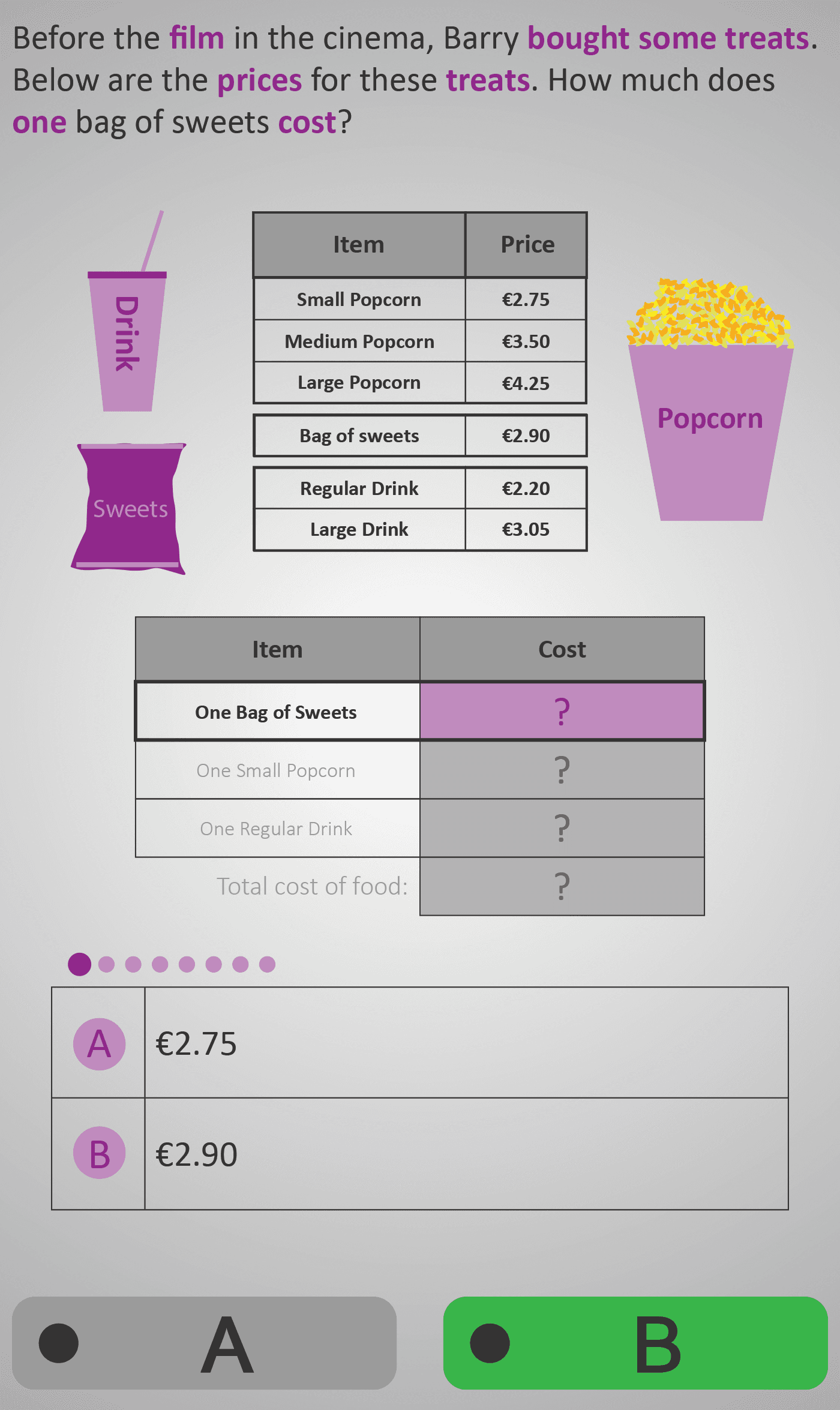
This Phlow extends earlier Total Cost lessons by introducing subtotals and cumulative addition in a relatable setting — a trip to the cinema. Students identify individual item prices (popcorn, sweets, drink), add them to find a food subtotal, and then combine this with a ticket price to find the total cost of the visit.
The focus is on structured addition of money values using place value and grouping logic. Each stage isolates one reasoning step before integrating them into a final total.
Worked Example
Popcorn: €2.90
Sweets: €2.75
Drink: €2.20
Subtotal (Food) = €2.90 + €2.75 + €2.20 = €7.85

Ticket: €5.50
Total = €7.85 + €5.50 = €13.35
Step Sequence
- Read the price table and identify relevant items.
- Add each food item’s price to find the subtotal.
- Carry forward the subtotal to the next step.
- Add the ticket price to get the overall total.
- Check that your answer is reasonable based on rounded estimates.
Sample Prompts
- “What is the total cost of all the food items?”
- “What is the final total including the cinema ticket?”
- “Which operation should you use to find the total cost?”
Why This Matters
This Phlow teaches how to manage and verify everyday costs, helping students connect classroom maths with daily spending decisions. Understanding how to add subtotals and totals supports both budgeting and digital payment literacy.
Prerequisite Knowledge Required
- Adding grouped items correctly (Total Cost 4B).
- Understanding money notation (euro and cent).
- Basic table reading and data extraction skills.
- Fluency with decimal addition and calculator use.
Linked Phlows:
Total Cost 4C – Comparing Payment Options,
Total Cost 4B – Adding Grouped Items,
Addition 3B – Adding Decimals,
Money 3A – Reading Prices.
Main Category
Number → Arithmetic → Addition in Money Contexts
Estimated Completion Time
Approx. 10–14 seconds per question.
40 questions total → Total time: 7–10 minutes.
Cognitive Load / Step Size
Moderate. Each step isolates one decision: identifying, grouping, or adding. By separating food totals from overall totals, the Phlow models real-world sequencing found in receipts. The visual structure ensures cognitive demand remains manageable.
Language & Literacy Demand
Low-to-moderate. Instructions are concise and reinforced visually with item icons and colour-coded price tables. Keywords like “total”, “subtotal”, and “cost” are highlighted in purple to anchor comprehension.
Clarity & Design
- Clear correspondence between icons and table rows (popcorn, drink, ticket).
- Consistent colour-coding (purple highlights) for active values.
- Subtotals and totals aligned vertically to support place-value logic.
- Stepwise layout mirrors how receipts and real cost tables are read.
Curriculum Alignment (ROI Junior Cycle Mathematics)
- Strand: Number – Money & Decimals
- Learning Outcomes: Add and combine money amounts; interpret price lists and receipts; calculate and estimate totals; apply arithmetic in everyday purchase contexts.
Engagement & Motivation
The cinema storyline makes the maths relatable and fun. Students recognise the scenario and stay engaged as the total builds across the screens, mirroring how totals are calculated in real purchases.
Error Opportunities & Misconceptions
- Adding instead of multiplying (for unrelated problems).
- Omitting one item or subtotal.
- Misplacing decimal points in addition.
- Forgetting to include the final ticket price.
Transferability / Real-World Anchoring
Strong. These skills transfer directly to managing transactions, checking receipts, and budgeting for outings or shopping. Builds financial confidence through familiar and meaningful contexts.
Conceptual vs Procedural Balance
Procedural with conceptual reinforcement. Students practise addition steps while conceptually understanding why subtotals precede totals — a foundational skill in structured financial reasoning.
Learning Objectives Addressed
- Identify relevant prices from a table.
- Add multiple decimal amounts to find subtotals.
- Combine subtotals and totals accurately.
- Interpret totals in realistic purchase scenarios.
What Your Score Says About You
- Less than 20: You can read prices but need practice combining multiple items correctly.
- 21–29: You understand addition of decimals but may omit items or misread totals.
- 31–39: You calculate accurately and apply subtotal logic confidently.
- 40 / 40: You’ve mastered real-world money addition — fluent, accurate, and ready for budgeting challenges.