
Total Cost 4F
Overview
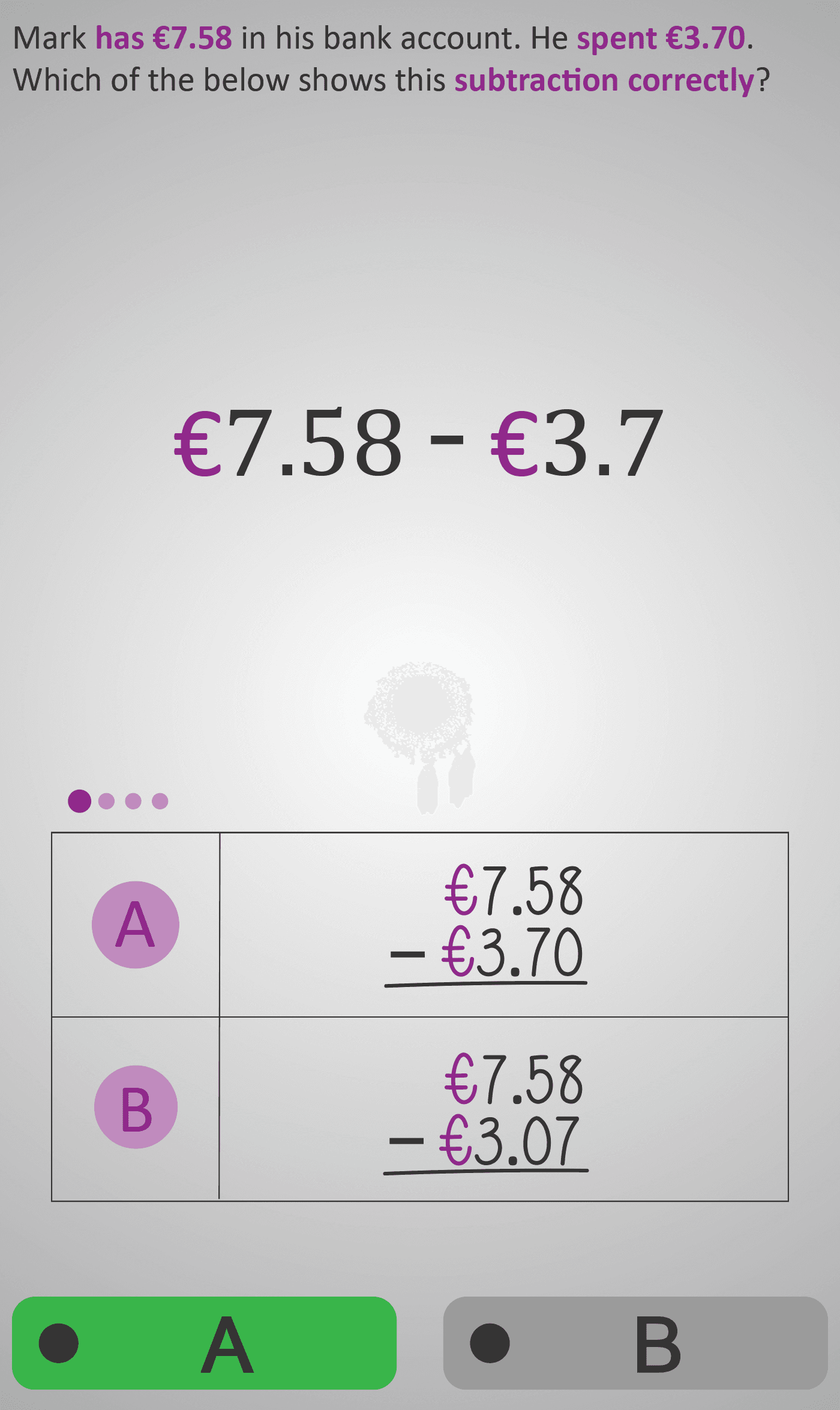
This Phlow introduces the written subtraction method for money amounts, linking real-world financial reasoning with structured calculation. Learners calculate “how much is left” after a purchase or withdrawal by subtracting one decimal amount from another (e.g., €7.58 − €3.70 = €3.88).
The Phlow visually models each stage of column subtraction with decimals, helping learners understand not just what to do, but why.
Worked Example
Mark has €7.58 and spends €3.70.

Setup:  €7.58
       − €3.70
        -------
Step 1: Align decimals vertically.
Step 2: Borrow if the top digit is smaller (5 − 7 → borrow → 15 − 7 = 8).
Step 3: Subtract each column carefully.
Answer: €3.88
Step Sequence
- Set up subtraction with decimal points aligned.
- Borrow from the next column if needed (tens to ones, euros to cents).
- Subtract digits column by column.
- Copy down the decimal point in the same position.
- Interpret the result as “money left.”
Sample Prompts
- “Which number goes on top in the subtraction?”
- “What happens if the top digit is smaller than the bottom digit?”
- “What is the total amount of money left?”
Why This Matters
Subtraction of decimals is one of the most common real-world numeracy skills. From balancing budgets to checking change, this Phlow equips students to calculate confidently and accurately when dealing with euros and cents.
Prerequisite Knowledge Required
- Total Cost 4E – Percentage and subtraction in money problems.
- Subtract 3A – Subtraction without borrowing.
- Decimals 3B – Understanding place value to two decimal places.
- Money 3A – Linking euro and cent to decimal form.
Main Category
Arithmetic → Subtraction → Decimals & Money
Estimated Completion Time
Approx. 10–14 seconds per question.
40 questions total → Total time: 7–10 minutes.
Cognitive Load / Step Size
Moderate. Each screen isolates a single skill — aligning decimals, borrowing, or performing column subtraction — before combining them. This steady progression maintains focus without cognitive overload.
Language & Literacy Demand
Low. Instructions are short, direct, and supported by visual cues (hand icons, euro symbols, purple highlights). Learners rely primarily on visual and numeric reasoning rather than text-heavy explanations.
Clarity & Design
- Step-by-step animation of the subtraction layout.
- Consistent purple and grey palette for focus.
- Visual indicators (e.g., arrow for borrowing) reinforce logic.
- Decimal points aligned vertically for clear place-value awareness.
Curriculum Alignment (ROI Junior Cycle – Number)
- Subtract decimal numbers accurately to two decimal places.
- Apply borrowing (decomposition) when required.
- Represent and solve real-life money problems.
Engagement & Motivation
The everyday context of spending money makes the task immediately relevant. Animated demonstrations of handwritten subtraction enhance engagement and confidence.
Error Opportunities & Misconceptions
- Misalignment of decimal points or digits.
- Forgetting to borrow or reducing the wrong column.
- Subtracting smaller from larger numbers incorrectly (reversing order).
- Dropping or misplacing the decimal in the answer.
Transferability / Real-World Anchoring
Strong. These skills apply directly to everyday money use — spending, banking, change, and budgeting — strengthening real-world financial confidence.
Conceptual vs Procedural Balance
Balanced. While procedural fluency is central, the context of “money left” ensures conceptual understanding of what subtraction represents in practical life.
Learning Objectives Addressed
- Subtract decimal amounts using the column method.
- Apply borrowing across digits correctly.
- Align decimals precisely to maintain place value.
- Interpret subtraction as finding remaining amounts.
What Your Score Says About You
- Less than 20: You can set up subtraction but struggle with borrowing — review earlier subtraction Phlows.
- 21–29: You understand the steps but misapply borrowing occasionally — practise slower for accuracy.
- 31–39: You’re accurate and fluent — ready for more complex percentage or multi-step money problems.
- 40 / 40: Excellent mastery of decimal subtraction — precise, confident, and real-world ready.