
Translation 4A
Overview
In this Phlow, students explore translation — a geometric movement in a straight line where every point of a shape moves the same distance and direction.
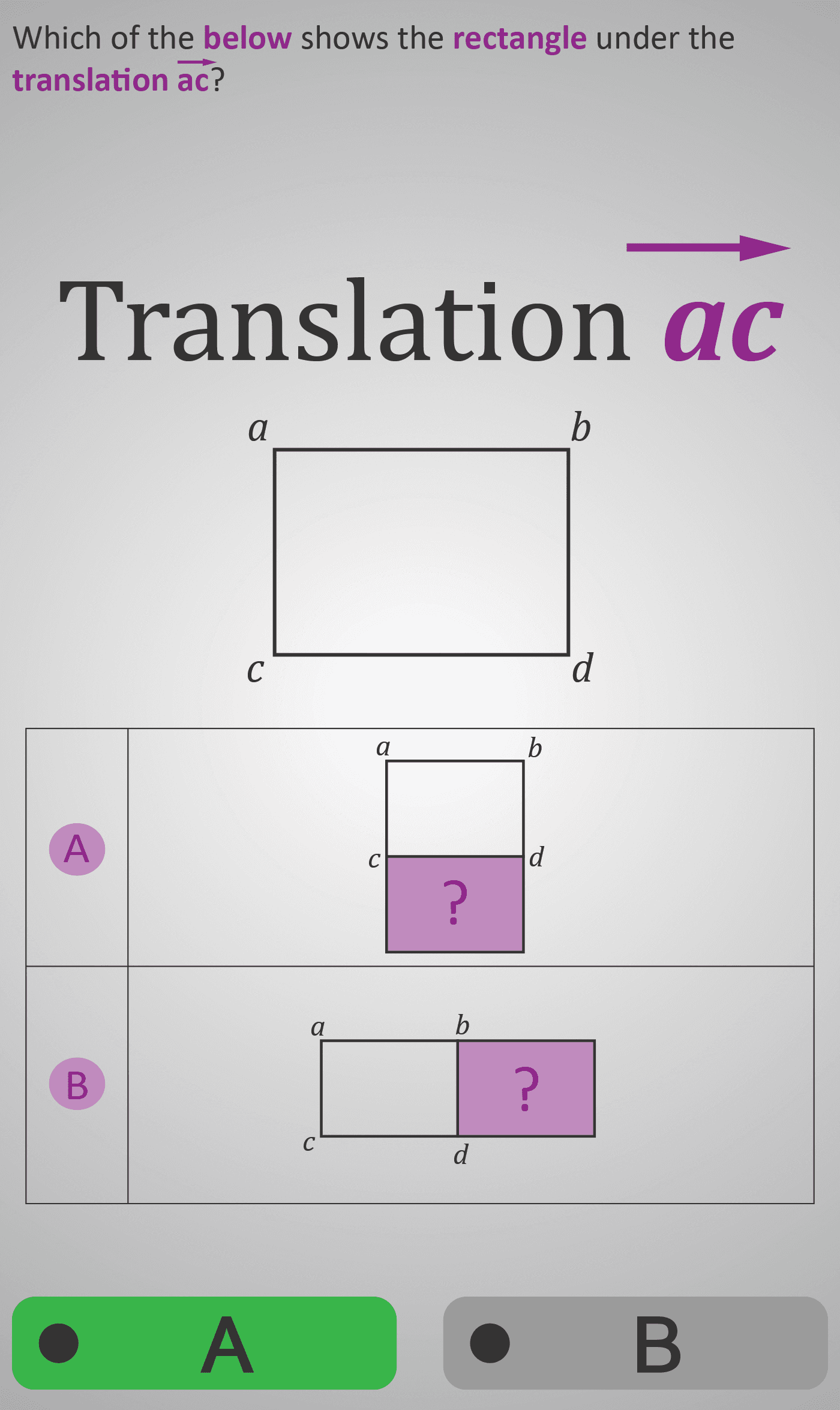
Shapes such as triangles, rectangles, and parallelograms are shown shifting under given vectors like ab or ac, helping students visualise translation as a slide rather than a turn or flip.
Worked Example
Given translation ab:
Every vertex of the triangle moves in the same direction and distance as vector ab.
The new shape is identical in size, shape, and orientation.
Only its position changes.
Step Sequence
- Observe the original labelled shape (vertices a, b, c, d, etc.).
- Identify the translation vector (e.g., ab or a→e).
- Visualise or trace the direction and distance of movement.
- Select the diagram that shows the entire shape moved accordingly.
Sample Prompts
- “Which diagram shows the triangle under the translation ab?”
- “What happens to the size or orientation of the shape?”
- “Does every vertex move the same distance?”
Why This Matters
Translation is a foundation of geometric transformation. Understanding it builds spatial awareness and prepares students for more advanced topics like co-ordinate geometry, vectors, and symmetry.
Prerequisite Knowledge Required
- Shapes 3B – Naming and identifying polygons and vertices (a, b, c, d).
- Lines & Directions 3C – Understanding horizontal and vertical movement.
- Translation 3A – Basic understanding of movement and position in a grid.
Main Category
Geometry → Transformations → Translation
Estimated Completion Time
Approx. 10–14 seconds per question.
40 questions total → Total time: 7–10 minutes.
Cognitive Load / Step Size
Low-to-moderate. Each example adjusts only one variable (shape or vector). Cognitive effort focuses on recognising consistent movement across all vertices. Step size is carefully graded to sustain engagement without confusion.
Language & Literacy Demand
Minimal. Sentences are concise, and key terms (translation, triangle, below) are bolded and colour-coded. The task relies primarily on visual reasoning rather than reading comprehension.
Clarity & Design
- Clean, uncluttered diagrams with labelled vertices.
- Consistent purple arrows to indicate translation direction.
- Two-option layout (A/B) to reduce visual overload.
- White background enhances line and vector clarity.
Curriculum Alignment (ROI Junior Cycle – Geometry & Measures)
- Recognise and describe translations.
- Identify movement of shapes without resizing or rotating.
- Interpret and use vector notation in describing transformations.
Engagement & Motivation
The visual puzzle-like format creates active participation — learners test hypotheses by selecting the correct shifted shape, making geometry intuitive and engaging.
Error Opportunities & Misconceptions
- Confusing direction (ab vs ba).
- Thinking translation flips or rotates the shape.
- Tracking only one vertex instead of the whole figure.
- Assuming size or orientation changes during translation.
Transferability / Real-World Anchoring
Strong. Translations underpin navigation, design layouts, CAD modelling, and symmetry in art and architecture — making this concept both abstractly mathematical and practically relevant.
Conceptual vs Procedural Balance
Primarily conceptual. Students learn the meaning of translation before performing mechanical identification — a visual reasoning task, not a memorisation one.
Learning Objectives Addressed
- Recognise translation as movement preserving shape and orientation.
- Interpret and apply vector notation correctly.
- Match original and translated figures accurately.
- Differentiate translation from reflection or rotation.
What Your Score Says About You
- Less than 20: Still developing understanding of direction and movement — revisit 3A for grid translations.
- 21–29: Tracking movement well but may confuse direction vectors.
- 31–39: Strong grasp of translation and invariance; occasional left/right mix-ups.
- 40 / 40: Excellent spatial reasoning — ready for co-ordinate geometry and vector-based problems.