
Translation 4B
Overview
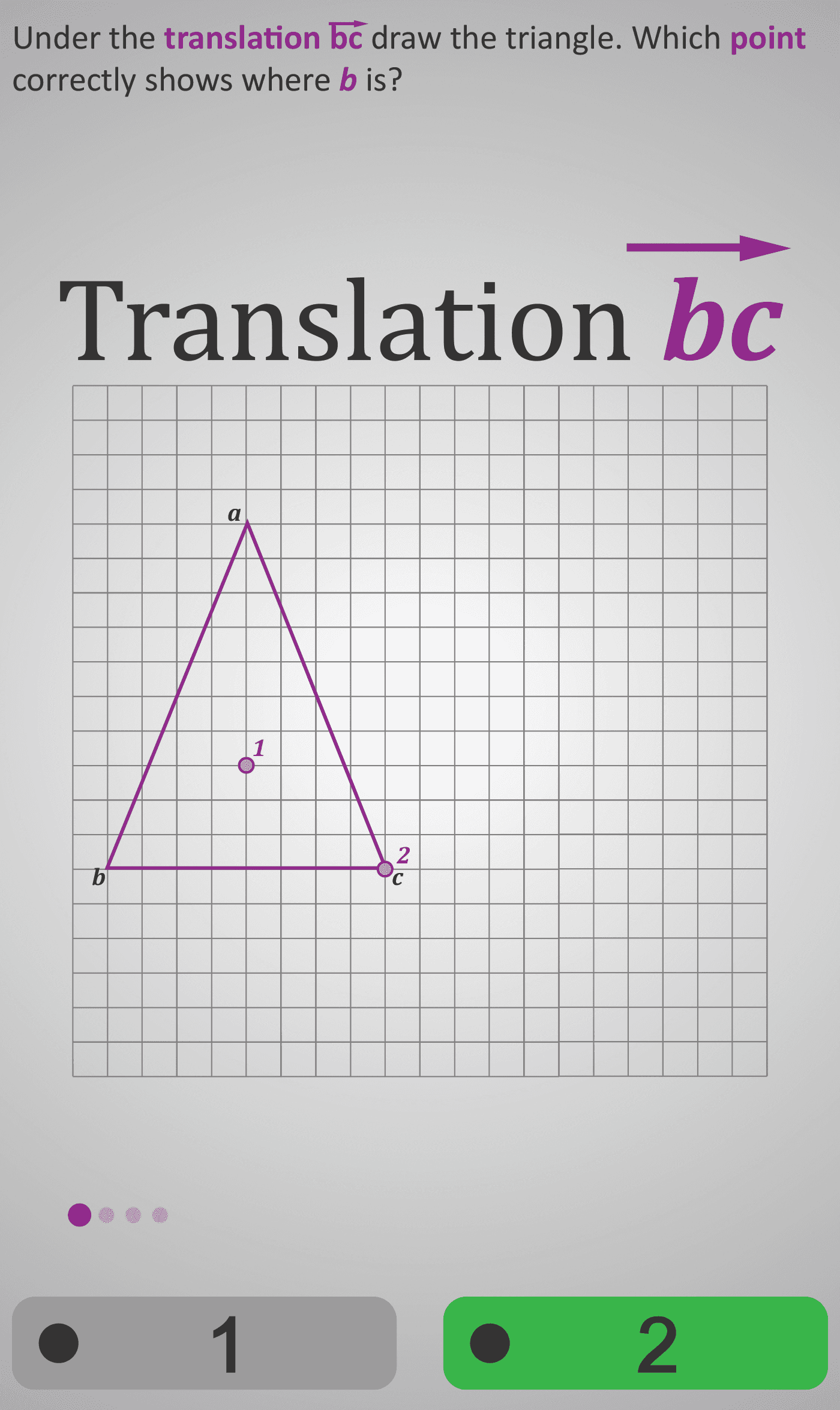
This Phlow guides students through performing a translation on a square grid.
Using a triangle labelled a, b, and c, learners apply a given vector (such as bc) to move each vertex by the same distance and direction.
The result is a new triangle congruent to the original — simply shifted, not rotated or resized.
Worked Example
Given vector bc:
• Move vertex b to its new position along the arrow.
• Move vertex a the same distance and direction.
• Move vertex c the same distance and direction.
The new triangle a'b'c' is the translated image of abc.
Step Sequence
- Identify the translation vector (e.g., bc).
- Locate vertex b and mark its new position using the vector.
- Translate vertices a and c by the same distance and direction.
- Connect the new vertices to complete the translated triangle.
Sample Prompts
- “Which point correctly shows where b is after the translation bc?”
- “Which option shows the completed triangle after translation?”
Why This Matters
By constructing translations on a grid, learners transform abstract ideas of movement into concrete visual logic. This skill lays the groundwork for understanding coordinate geometry, vectors, and symmetry in higher-level maths.
Prerequisite Knowledge Required
- Translation 4A – Recognising translations and interpreting direction vectors.
- Co-ordinates 3B – Understanding grid positions and plotting points.
- Shapes 3B – Identifying vertices and naming triangles.
Main Category
Geometry → Transformations → Translation on Grid
Estimated Completion Time
Approx. 10–14 seconds per question.
40 questions total → Total time: 7–10 minutes.
Cognitive Load / Step Size
Moderate. The process involves multiple visual and spatial judgements, but each screen isolates one action — translating a single vertex — to ensure smooth and logical progression. Step size is gradual and cumulative, maintaining conceptual clarity.
Language & Literacy Demand
Low. Short, direct instructions like “Translate point b.” Key terms (translation, vector, point) are highlighted in purple, ensuring accessibility for all reading levels.
Clarity & Design
- Square grid provides visual precision for movement tracking.
- Vector arrows clearly mark direction and magnitude.
- Colour consistency (purple lines, green highlights) supports focus.
- Sequential build-up of vertices and triangle reinforces stepwise logic.
Curriculum Alignment (ROI Junior Cycle – Geometry & Measures)
- Perform and describe translations on a grid.
- Recognise that translations preserve size, shape, and orientation.
- Apply vector notation to represent geometric movement.
Engagement & Motivation
The visual interactivity of plotting points and seeing shapes “slide” keeps learners engaged. Each question feels like a small puzzle, providing instant feedback and satisfaction.
Error Opportunities & Misconceptions
- Reversing the direction of the vector (e.g., bc vs cb).
- Translating only one vertex incorrectly.
- Counting grid squares diagonally instead of horizontally/vertically.
- Failing to move all vertices parallel and equal distances.
Transferability / Real-World Anchoring
Strong. The principles of translation appear in computer graphics, architecture, design software, and navigation systems. Understanding equal movement enhances spatial awareness in diverse contexts.
Conceptual vs Procedural Balance
Balanced. Conceptual insight (every vertex moves equally) supports procedural accuracy (measuring and plotting on a grid). Students develop both spatial intuition and practical precision.
Learning Objectives Addressed
- Translate shapes on a coordinate grid using a given vector.
- Identify corresponding vertices after translation.
- Recognise invariance in size, shape, and orientation.
- Apply directional vectors accurately to complete transformations.
What Your Score Says About You
- Less than 20: You can recognise translations but need more grid practice — revisit 4A first.
- 21–29: You understand direction but may miscount or misplace vertices occasionally.
- 31–39: Solid grasp of translation accuracy — minor slips in grid precision.
- 40 / 40: Excellent precision and reasoning — fully confident with vector-based transformations.