
Translation 4C
Overview
In this Phlow, students move from recognising translations to constructing them accurately using geometric instruments.
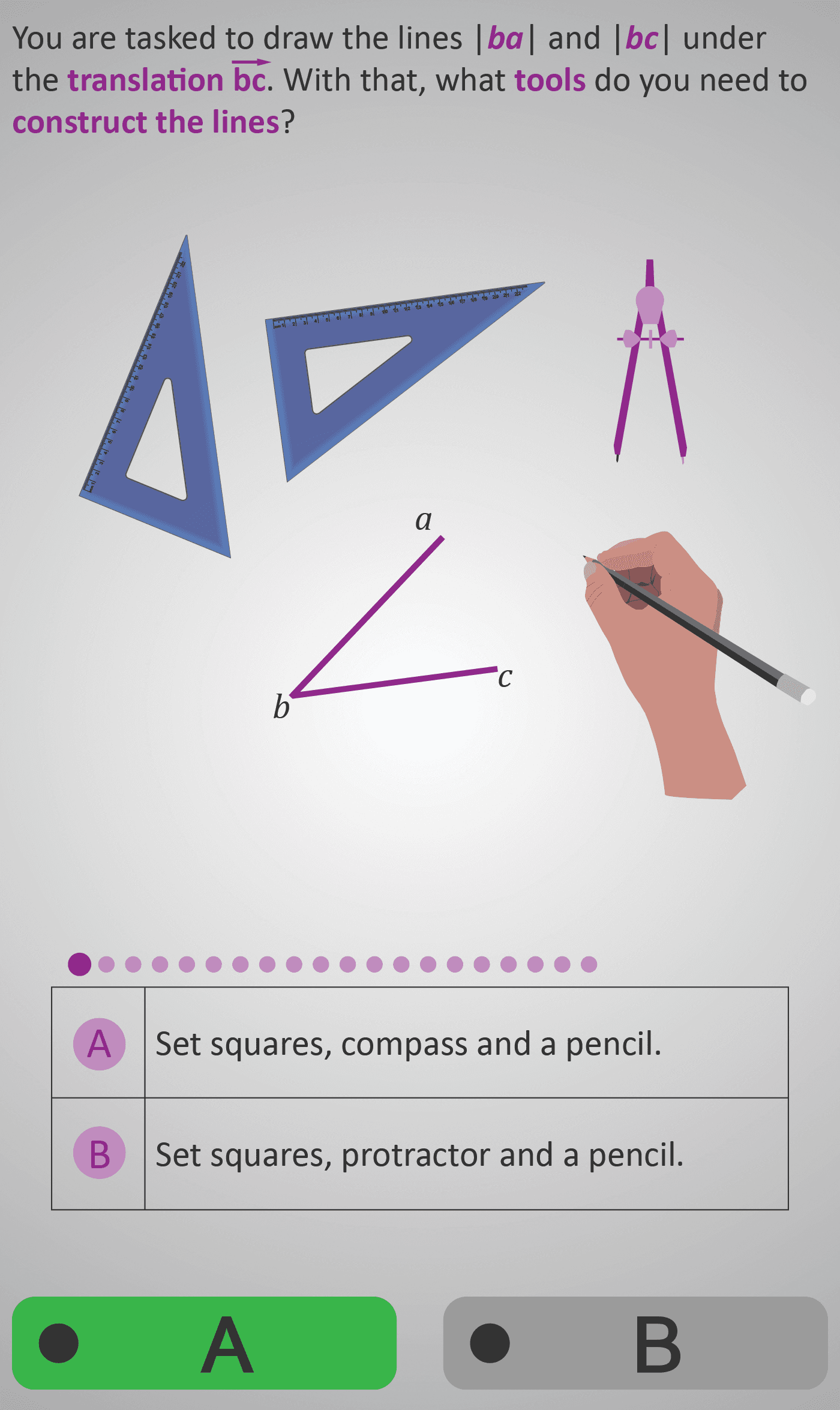
Learners replicate the translation of a shape along a vector such as bc, using compass, ruler, and set squares to ensure precision.
This hands-on approach bridges conceptual geometry and technical drawing.
Worked Example
Vector: bc
Tools: Compass, Ruler, Set Squares

1. Identify vector bc and its direction.
2. Draw construction lines parallel to bc.
3. Use a compass to transfer the distance of bc.
4. Slide a set square along another to maintain parallelism.
5. Mark new vertices (a’, b’, c’) to complete the translated shape.
Step Sequence
- Recognise the vector’s direction and magnitude.
- Draw construction lines parallel to the translation vector.
- Use a compass to copy the exact distance of movement.
- Position and slide set squares to maintain alignment.
- Mark translated points and complete the shape accurately.
Sample Prompts
- “Which shows the correct translation using vector bc?”
- “Which construction keeps the lines parallel?”
- “Where should the compass arc be drawn?”
Why This Matters
This Phlow connects mathematical reasoning with technical precision. Students experience how geometric constructions underpin design, engineering, and architecture — learning not only how to translate shapes, but why accuracy and method matter.
Prerequisite Knowledge Required
- Translation 4B – Performing translations on a grid.
- Drawing Tools 3B – Using compass, ruler, and set squares correctly.
- Line & Angle Basics 3C – Understanding parallel and perpendicular lines.
Main Category
Geometry → Transformations → Construction of Translation
Estimated Completion Time
Approx. 10–14 seconds per question.
40 questions total → Total time: 7–10 minutes.
Cognitive Load / Step Size
Moderate-to-high. Students progress from conceptual reasoning to procedural precision. Each micro-step (direction → distance → parallel line → final mark) adds only one new layer of thinking, ensuring clarity while maintaining engagement through active construction.
Language & Literacy Demand
Moderate. Introduces key technical terms (arc, parallel, compass, construction line) but supports them visually through instrument icons and purple highlighting, reducing reading strain.
Clarity & Design
- Purple lines differentiate construction from final shape.
- Realistic depictions of tools (compass, ruler, set squares).
- Step-by-step animations with progress dots for pacing.
- Clean A/B comparison keeps focus on correct geometric relationships.
Curriculum Alignment (ROI Junior Cycle – Geometry & Measures)
- Perform and describe translations using instruments.
- Construct parallel lines and transfer lengths accurately.
- Understand geometric transformations in technical and design contexts.
Engagement & Motivation
The realistic “hands-on” construction context appeals strongly to visual and kinaesthetic learners. Students feel a sense of craftsmanship and control as they construct, not just observe, geometric precision.
Error Opportunities & Misconceptions
- Reversing the translation direction (bc vs cb).
- Starting construction from the wrong reference point.
- Misusing compass radius or alignment.
- Failing to keep set squares parallel when sliding.
Transferability / Real-World Anchoring
Very strong. The construction techniques directly link to Technical Graphics, Engineering Drawing, and Architecture. Students gain precision, discipline, and transferable spatial reasoning.
Conceptual vs Procedural Balance
Predominantly procedural, but grounded in conceptual logic — each instrument action corresponds to a geometric rule. Students learn why each step works as they perform it.
Learning Objectives Addressed
- Translate shapes accurately using geometric instruments.
- Construct parallel lines and equal-length vectors.
- Understand geometric reasoning behind construction methods.
- Apply accuracy and logical sequencing in geometric tasks.
What Your Score Says About You
- Less than 20: You understand translations but need to refine accuracy with instruments — review 4A and 4B first.
- 21–29: You can construct but may misapply direction or spacing — practise careful sequencing.
- 31–39: Accurate and confident with strong spatial control — excellent applied geometry.
- 40 / 40: Full mastery — precise, efficient, and ready for advanced composite transformations.