


Visual Algebra 4B
Overview
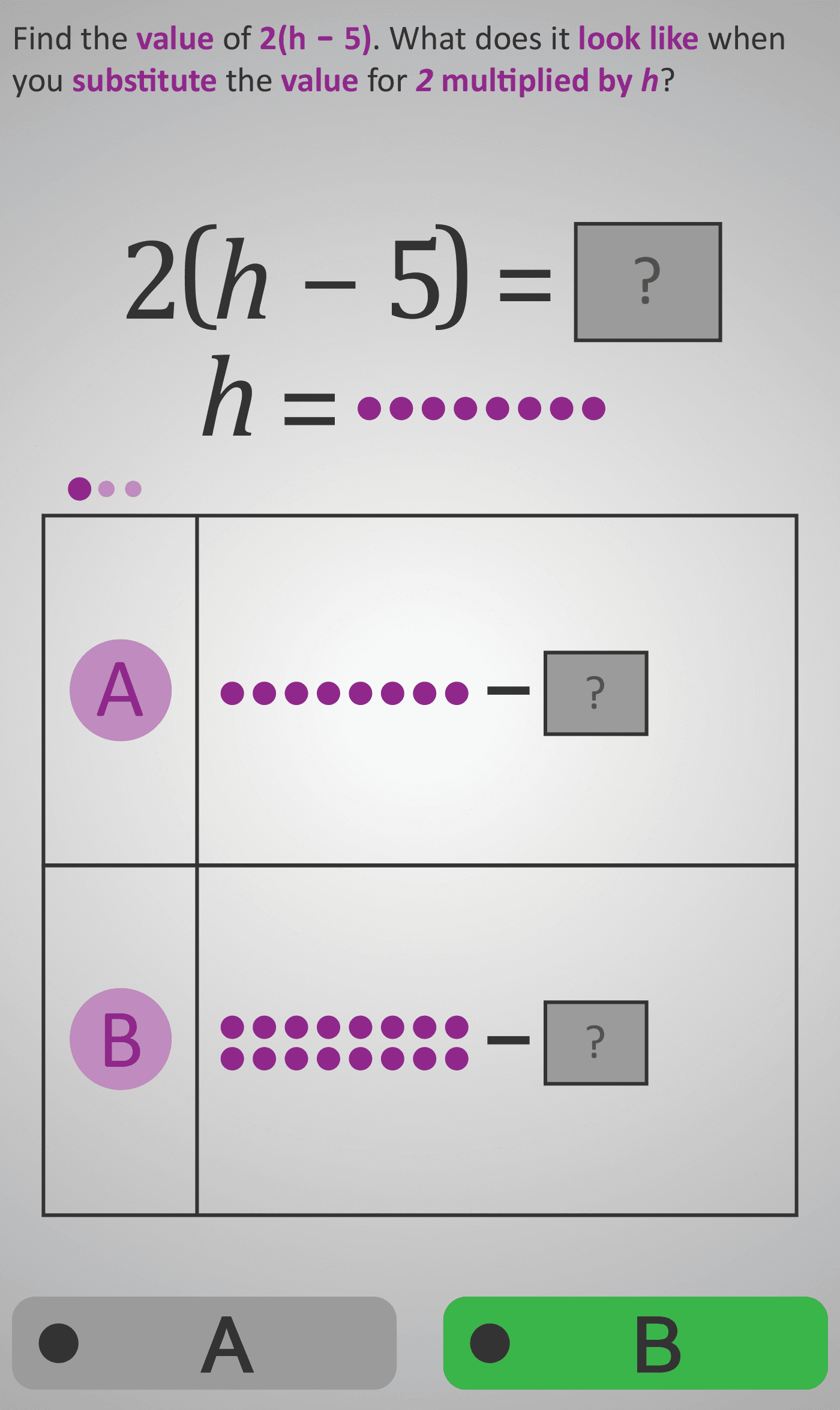
This Phlow builds understanding of brackets and distribution through visual substitution. Learners interpret the expression 2(h − 5) using dot arrays, showing how multiplication applies to every term within a bracket.
Learning Focus
Students first visualise what (h − 5) means — one group of h dots with five removed — then explore how multiplying by 2 doubles the entire group. This develops the logic behind 2(h − 5) = 2h − 10 without rote memorisation.
Worked Example
Expression: 2(h − 5)
If h = 8:
(h − 5) = 3
2 × 3 = 6
Therefore, 2(h − 5) = 6
Step Sequence
- Recognise what each part of the expression means visually.
- Substitute a value for h (e.g., h = 8).
- Perform subtraction first (inside the bracket).
- Multiply the result by 2 to complete the expression.
Why This Matters
This Phlow helps students see distribution before formalising it algebraically. By showing that multiplication applies to all terms inside a bracket, learners build a deep conceptual foundation for future topics like expanding and simplifying expressions.
Prerequisite Knowledge Required
- Comfort substituting into simple linear expressions.
- Understanding multiplication as repeated addition.
- Recognising brackets and order of operations.
- Linked Phlows: Visual Algebra 4A, Algebra 3C – Order of Operations.
Main Category
Algebra → Expressions and Brackets
Estimated Completion Time
Approx. 10–14 seconds per question.
40 questions total → Total time: 7–10 minutes.
Cognitive Load / Step Size
Moderate and well-sequenced. Students move from substitution to bracket evaluation to full visual distribution. Dot arrays act as cognitive scaffolds, keeping reasoning grounded while reinforcing structure and order of operations.
Language & Literacy Demand
Low. Clear, repetitive prompts like “Find the value of…” or “Which diagram shows…” reduce reading load. Visual reasoning dominates, supporting learners across literacy levels.
Clarity & Design
- Symmetrical layouts showing two groups for “×2”.
- Purple dot arrays illustrate h and −5 clearly.
- A/B comparison screens isolate correct versus common misconception diagrams.
- Minimalist design ensures focus on algebraic structure, not decoration.
Curriculum Alignment (ROI Junior Cycle – Algebra)
- Evaluate expressions involving brackets through substitution.
- Recognise and apply distribution in algebraic forms.
- Represent variable relationships symbolically and visually.
Engagement & Motivation
Students enjoy the tactile feel of “seeing” the maths. The interactive, dot-based puzzles create pattern satisfaction and visual clarity, making algebraic reasoning accessible and fun.
Error Opportunities & Misconceptions
- Forgetting to distribute 2 to both terms.
- Treating 2(h − 5) as 2h − 5.
- Subtracting from only one group instead of both.
- Mixing order of operations inside and outside brackets.
Transferability / Real-World Anchoring
Moderate. Understanding how scaling and subtraction interact supports functional relationships, budgeting, and proportional reasoning in real contexts. Builds a strong base for algebraic simplification and area models.
Conceptual vs Procedural Balance
Concept-heavy, procedural reinforcement. Learners understand why distribution works before formalising symbolic rules.
Learning Objectives Addressed
- Evaluate bracketed expressions by substitution.
- Understand that multiplication affects all terms inside a bracket.
- Connect visual grouping to symbolic distribution.
- Build intuitive understanding of algebraic structure.
What Your Score Says About You
- Less than 20: You’re recognising the symbols but missing how multiplication applies to all terms.
- 21–29: You can substitute correctly but still rely on visual cues — conceptual clarity emerging.
- 31–39: Strong grasp of visual and symbolic logic — consistent distribution understanding.
- 40 / 40: Excellent mastery — ready for expanding and simplifying algebraic brackets confidently.