


Personal Learning Journey
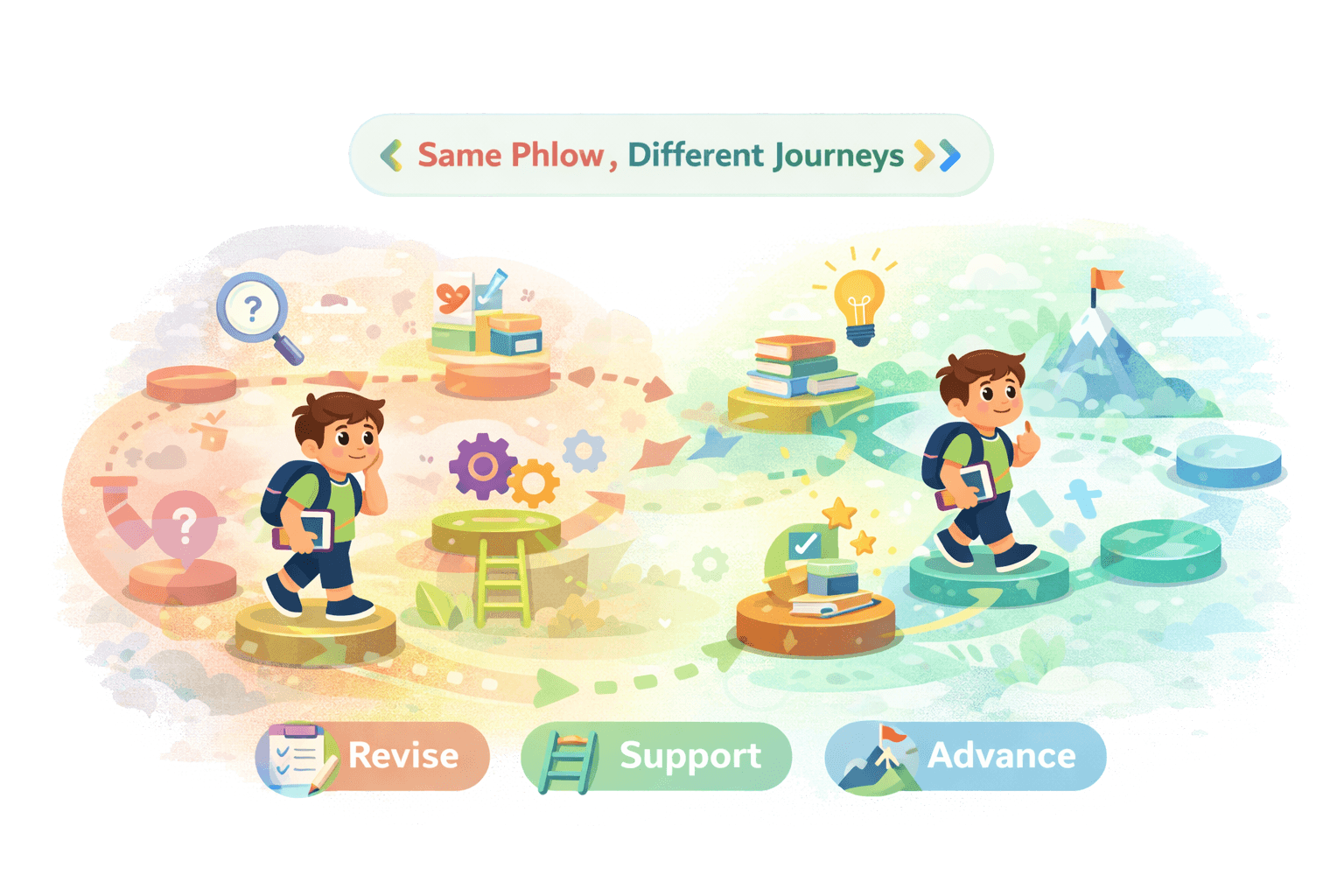
Phlow Academy guides each student along a personalised learning journey that adapts in real time to their understanding.

Personal Learning Journey
Learning does not happen in a straight line. It adapts, pauses, accelerates, revisits, and connects.
Phlow Academy’s Personal Learning Journey is designed to do exactly that — to build a dynamic sequence of decisions that responds to what a student actually understands, not what level or year group they belong to.
At every step, the journey learns from a student’s answers and decides what should come next, ensuring the student remains in flow: challenged, supported, and progressing toward mastery.
Learning That Responds to Understanding
Rather than pushing every student through the same content at the same pace, Phlow continuously adjusts the learning experience in response to what the student demonstrates.
The system adapts which decisions a student sees, how many decisions they are asked to complete, which Phlows are prioritised at any moment, and when support, revision, or progression should be introduced.
As a result, two students can work on the same Phlow and experience entirely different journeys through it — without either feeling rushed or held back. This approach is grounded in cognitive science: learning improves when challenge is calibrated to current ability, feedback is immediate, and success builds momentum.

Decision Density: Interpreting the Visual
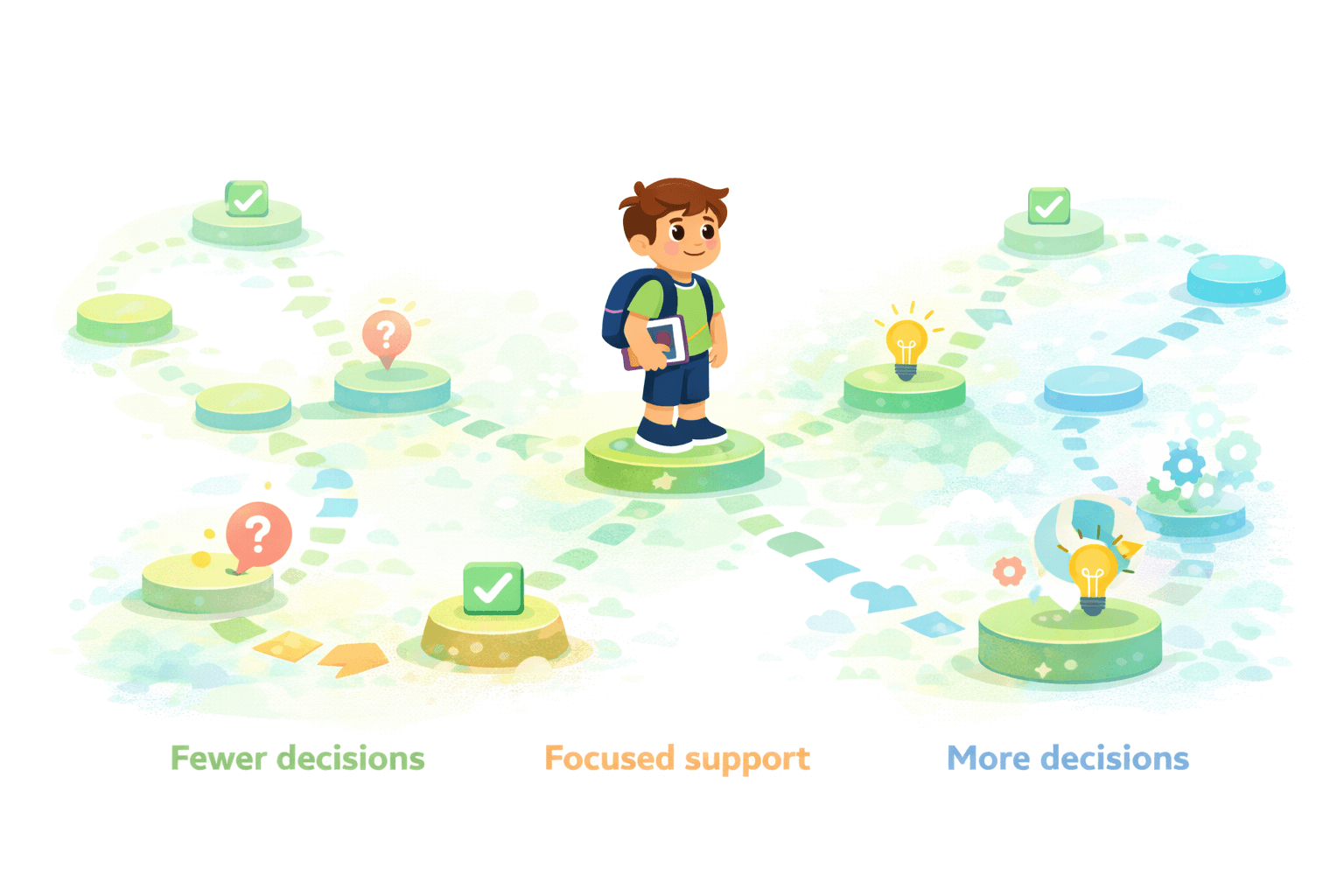
When viewing a Phlow through the lens of decision density, fewer decision points indicate confidence and fluency, while a denser cluster of decisions reflects developing understanding.
In some cases, a mixed density appears, allowing the system to focus support precisely where it is most needed.
This ensures that progression is based on knowledge and stability of understanding, rather than time spent or number of questions completed.
A Journey Designed for Mastery
The Personal Learning Journey is not a shortcut, and it is not a rigid path. It is a responsive system designed to keep students in flow, respect prior knowledge, support struggle without stigma, and adapt intelligently as understanding evolves over time.
Every decision matters, and every journey is uniquely shaped by the learner.
Judging Readiness to Move On
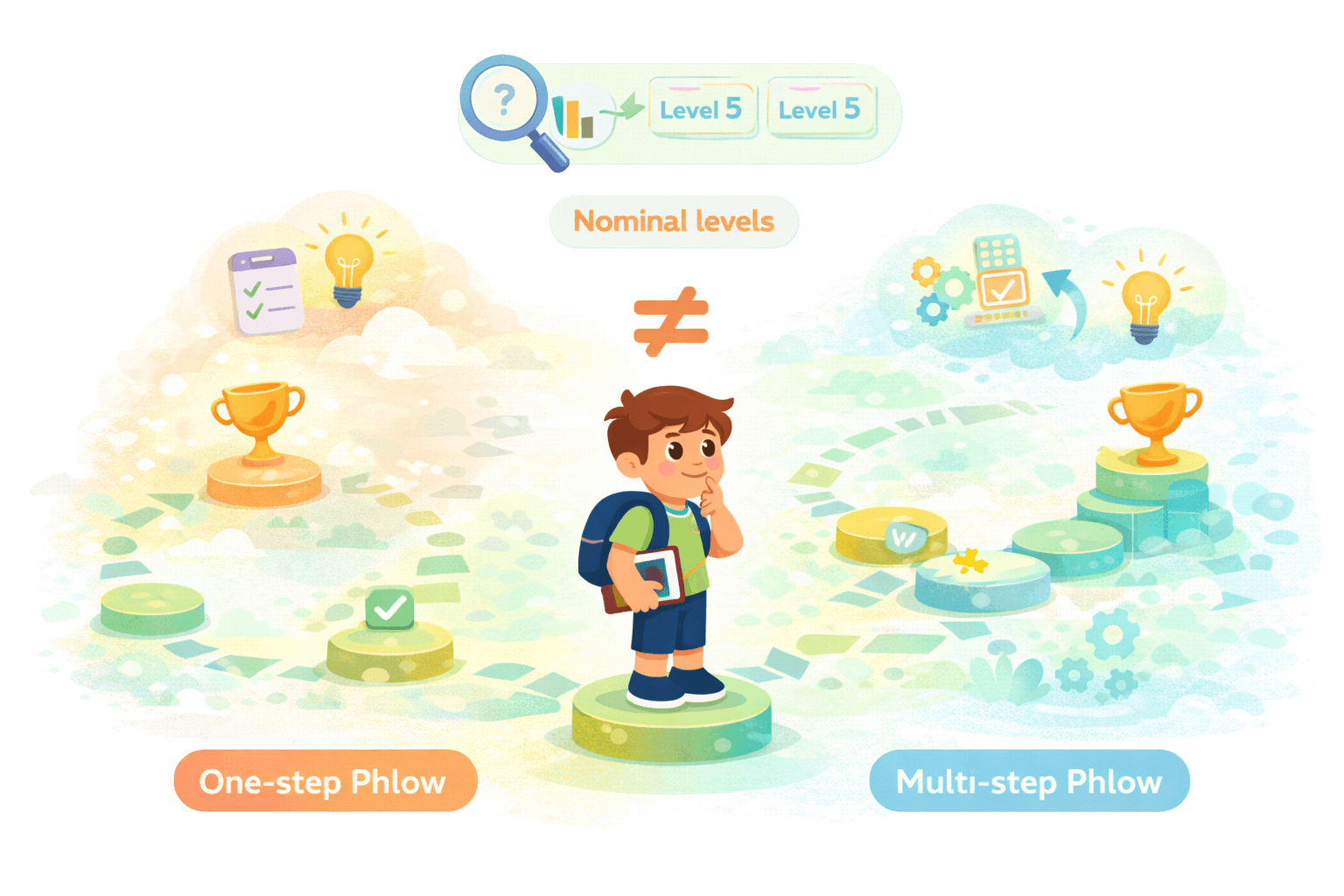
In Phlow Academy, readiness to progress cannot be judged using a single, uniform rule. Levels do not directly represent difficulty, Phlows do not all share the same internal structure, and questions can contain very different numbers of cognitive steps.
As a result, a one-step Phlow and a multi-step Phlow cannot be judged in the same way, even if they sit at the same nominal level.
To address this, Phlow shifts the unit of progress away from questions and toward something more fundamental.
From Questions to Decisions
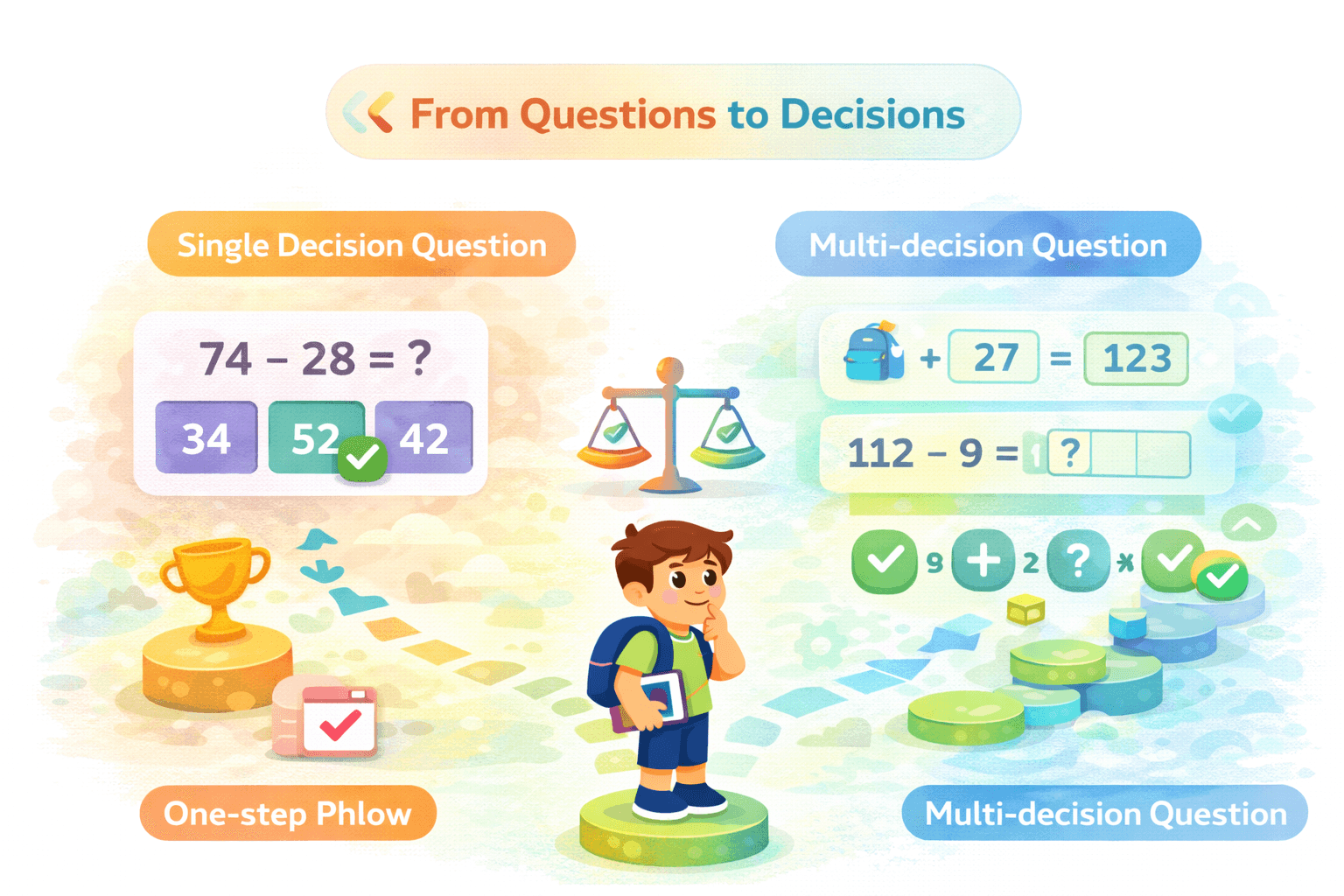
A decision is any point where the learner must commit to an answer. This may involve choosing a number, selecting an operation, identifying a missing value, classifying an object, or confirming a final result.
Some Phlows involve only a single decision, while others chain several decisions together within the same question.
By tracking decisions rather than questions, Phlow can compare learning fairly across very different Phlow structures, without relying on special cases or arbitrary rules.
This normalises progression across the entire platform, from early counting Phlows to advanced multi-step reasoning tasks.
Base Decision Value
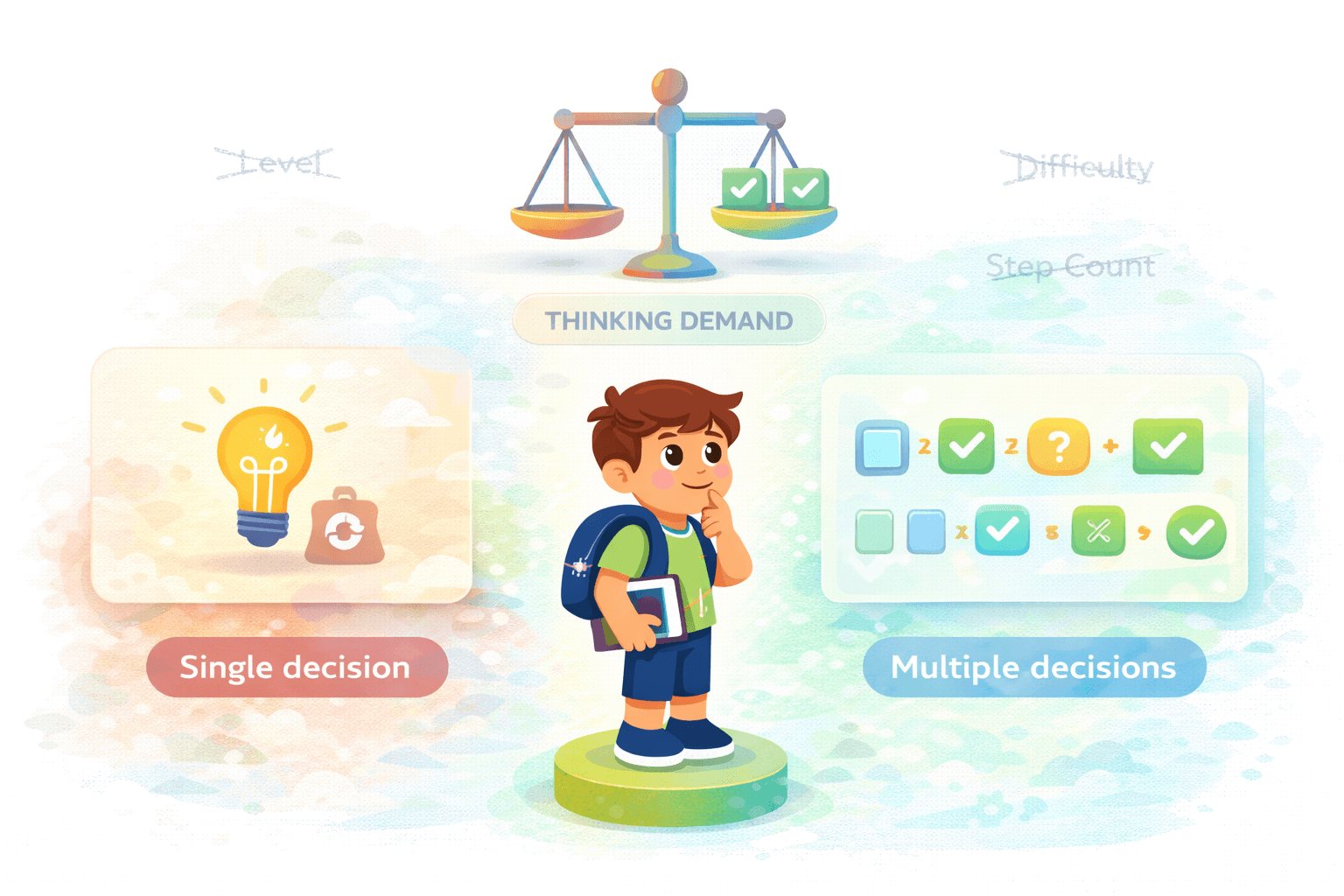
Base Decision Value (BDV) is not a level, not a difficulty label, and not a step count.
Instead, it is a neutral benchmark that describes how demanding a particular type of thinking usually is for an average student.
A single decision can carry a high BDV, while a multi-step Phlow may consist of several low-BDV decisions. This distinction allows Phlow to reason about thinking itself, rather than relying on surface indicators such as appearance or length.
Why BDV Matters
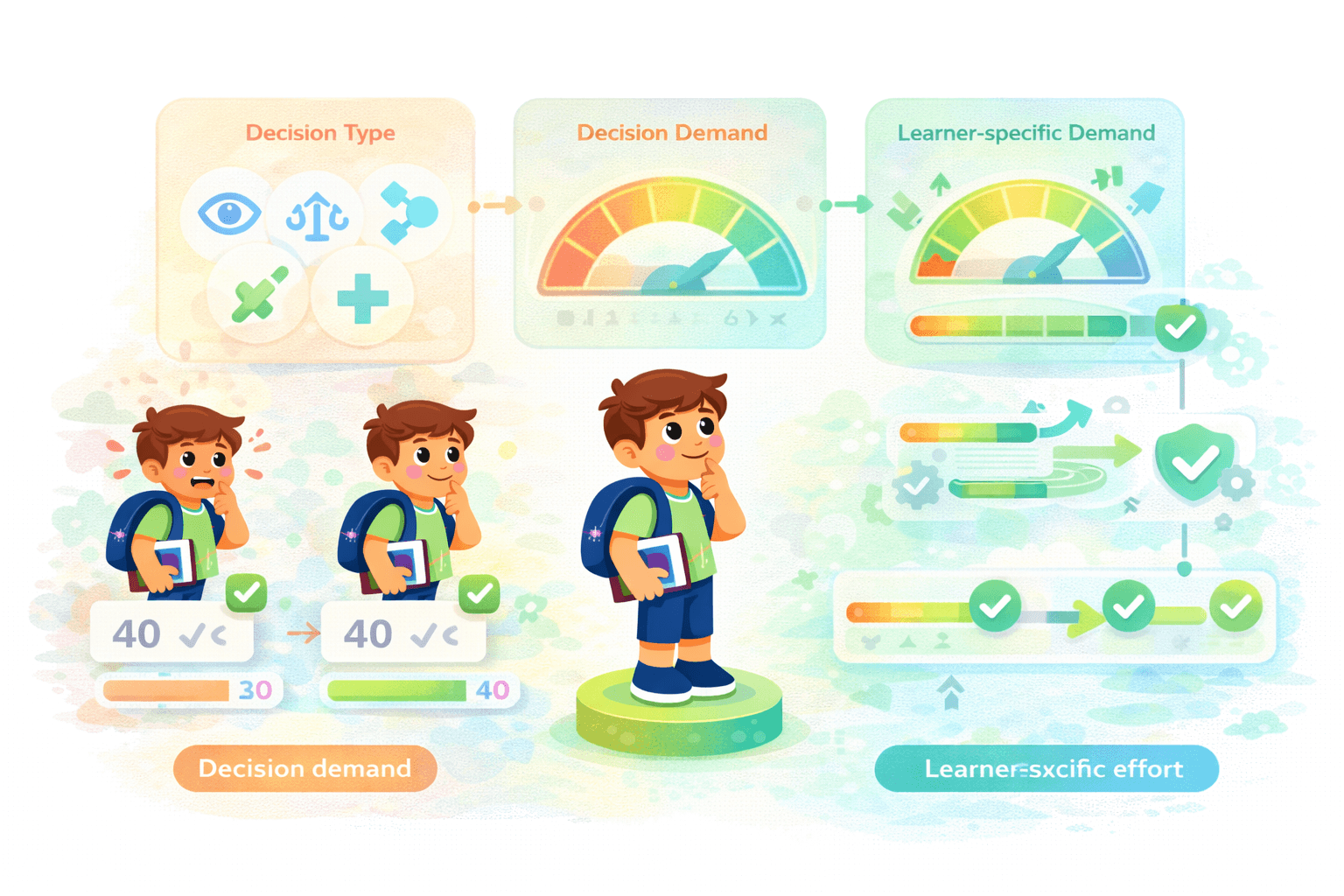
Base Decision Value allows the learning journey to distinguish clearly between three related but separate ideas.
First, it identifies what kind of decision is being made, such as recognition, comparison, symbol mapping, or operation choice.
Second, it captures how demanding that type of decision usually is, independent of context.
Finally, it allows the system to understand how demanding that same decision is for a particular student.
Without BDV, all learning signals collapse into a simple right-or-wrong outcome. With BDV, Phlow can recognise effort, growth, and stability, even when two students give the same answer.
Personalising Cognitive Load
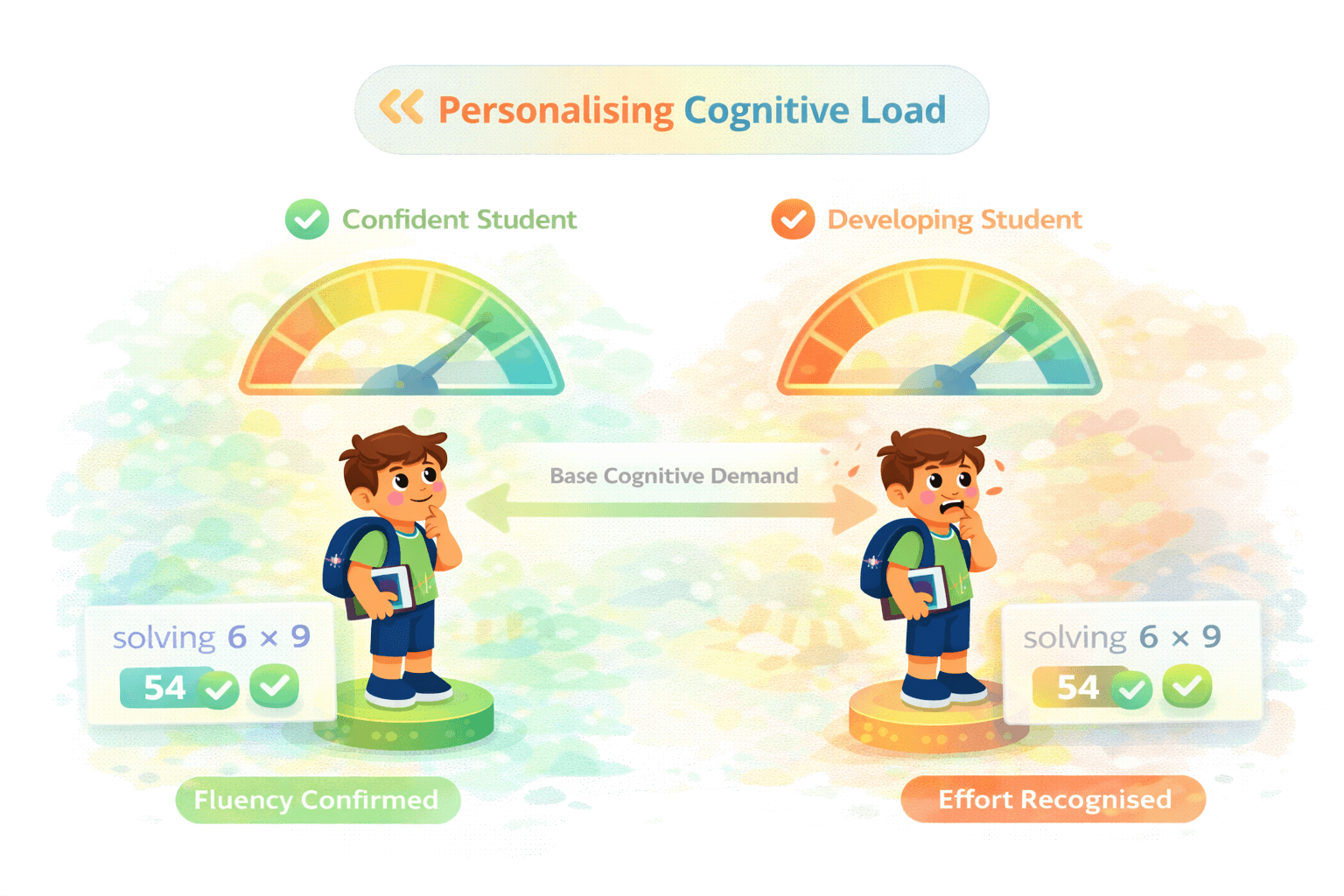
When a student answers a decision, the system does not simply record whether the response was correct.
Instead, it considers the base cognitive demand of the decision alongside how confidently that student typically handles that type of thinking.
For a confident student, a correct answer confirms fluency. For a developing student, the same correct answer represents meaningful cognitive effort.
Both signals matter, but in different ways. This ensures that strong students are not over-credited for easy wins, while developing students are recognised for genuine progress. Learning becomes effort-sensitive rather than outcome-biased.
Decision-Based Rolling Windows
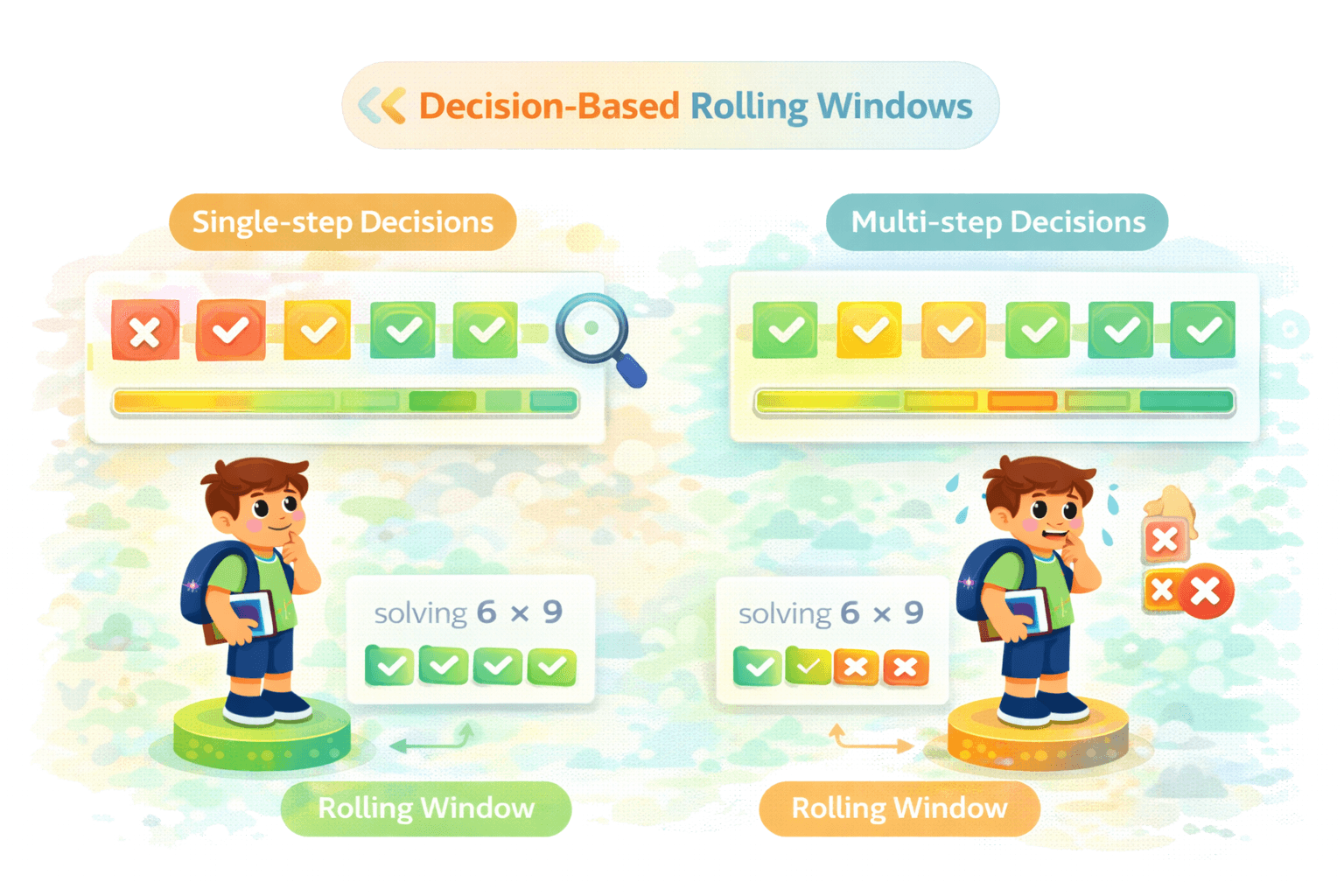
Because Phlows vary internally, progression cannot rely on a fixed number of questions. Instead, Phlow uses decision-based rolling windows, asking how much reliable understanding has been demonstrated across recent decisions.
Each decision contributes to a rolling window of evidence. Multi-step Phlows naturally fill this window faster than single-step Phlows, without changing the underlying rules.
This means learners performing well on complex tasks can progress sooner, instability becomes visible more quickly as cognitive load increases, careful thinkers are not penalised, and guessing is not over-rewarded.
Progression reflects the quality of thinking over time, not isolated performance.
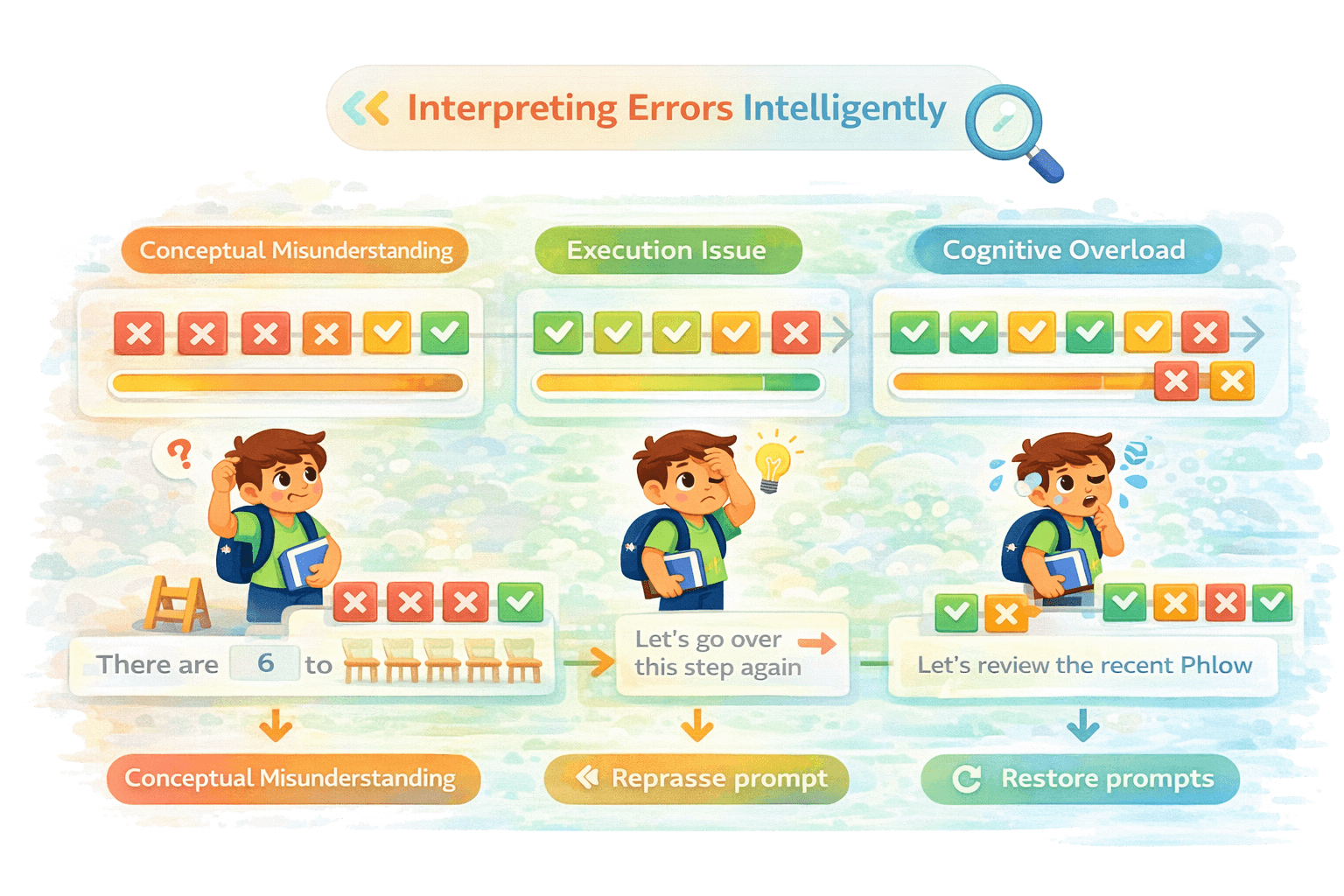
Interpreting Errors Intelligently
Errors are not treated equally. Because decisions are tracked individually, Phlow can identify meaningful patterns in how errors occur.
Repeated errors on the first step often indicate a conceptual misunderstanding, while errors confined to the final step suggest an execution issue rather than a lack of understanding.
Random errors across decisions may point to cognitive overload.
Recognising these patterns allows the learning journey to respond precisely — by rephrasing prompts, inserting visual support, or stepping the learner back one conceptual rung rather than resetting an entire Phlow.
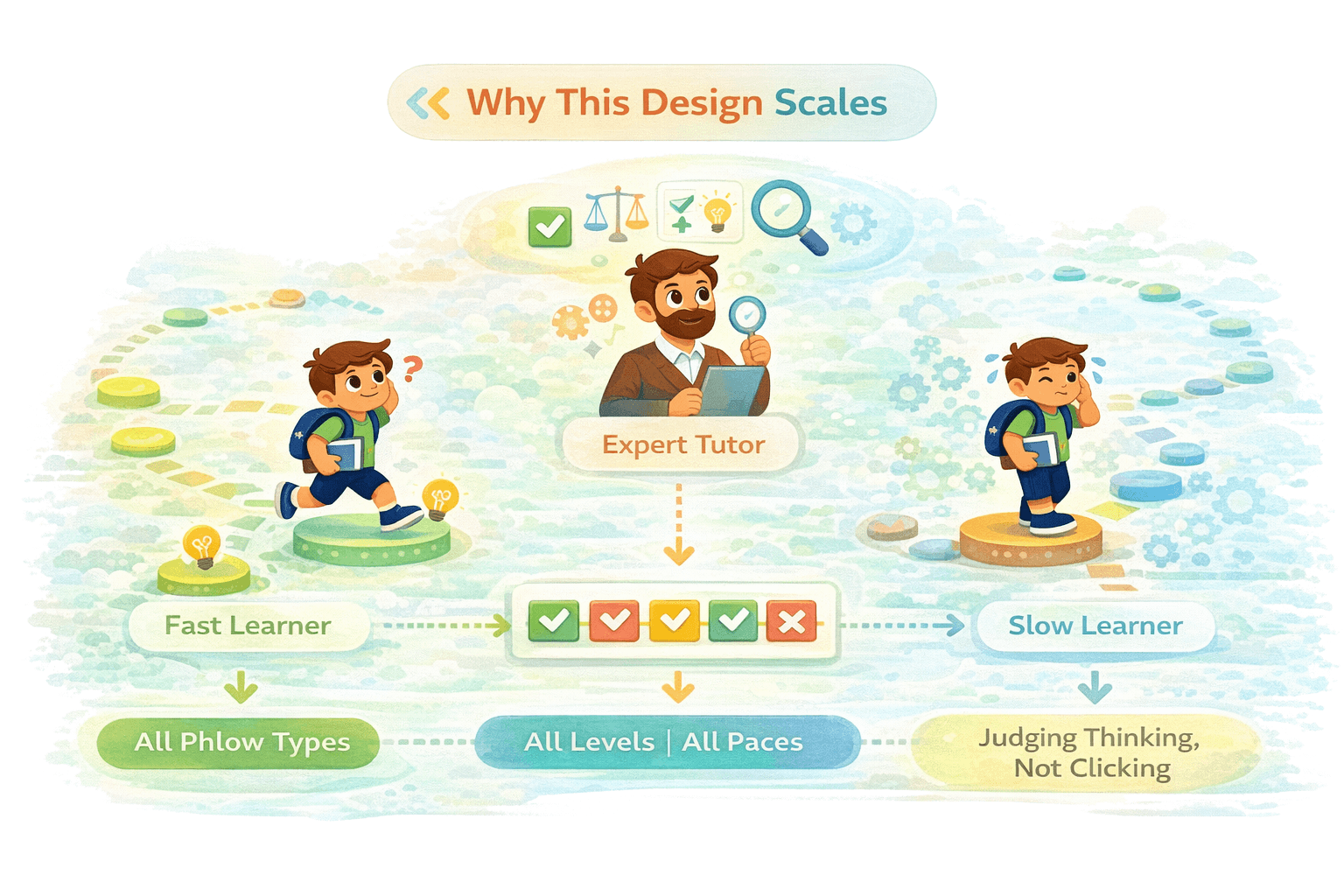
Why This Design Scales
This decision-based approach works across all Phlow types, across all levels, and for both fast and slow learners.
It mirrors how expert tutors judge readiness by observing patterns of reasoning over time rather than counting completed exercises.
Most importantly, it judges thinking rather than clicking.
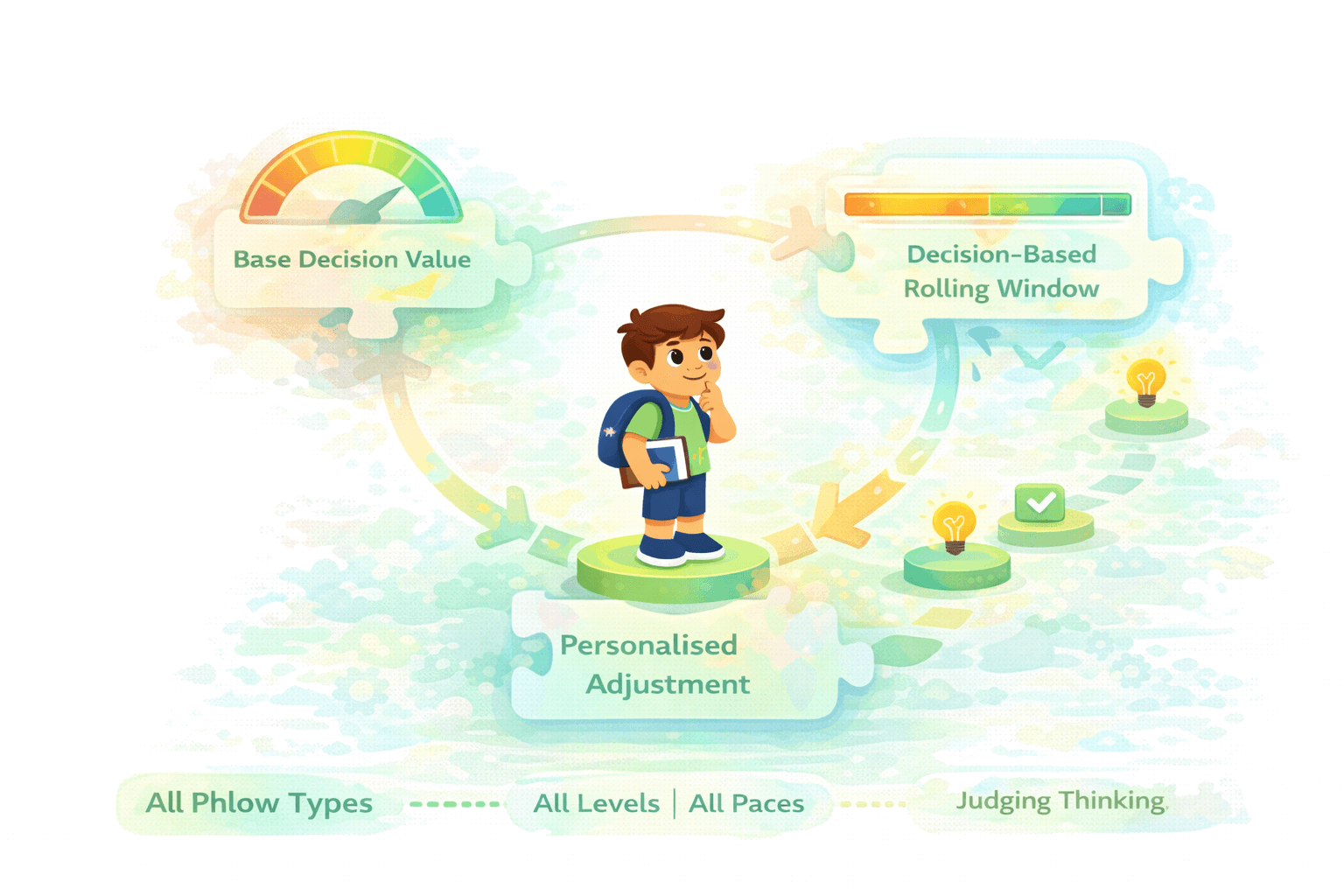
Bringing It All Together
Base Decision Value, decision-based rolling windows, and personalised adjustment together form the backbone of the Personal Learning Journey.
They ensure that progression is fair, support is targeted, mastery is meaningful, and every student’s path makes sense for them.
This is how Phlow Academy replaces rigid progression with responsive guidance — without losing structure, standards, or ambition.